
How to Learn German by Yourself: An Honest B1 to B2 Guide
Yes, you can learn German by yourself from B1 to B2. Two real, independently sourced estimates put the additional hours needed somewhere between 250 and




Yes, you can learn German by yourself from B1 to B2. Two real, independently sourced estimates put the additional hours needed somewhere between 250 and 500, on top of what B1 already required. This guide covers how to learn german by yourself at this specific stage, what the real hour data says, which methods genuinely work, and where they honestly stop being enough.
Reaching German B2 from B1 typically takes 250 to 500 additional hours, depending on which real, sourced estimate you use. Sprachschule.org’s own published sources give two related estimates that don’t perfectly agree with each other, worth stating plainly rather than picking one and hiding the gap.
Their 26-week study plan states the Goethe-Institut’s zero-to-B2 estimate at 600 total hours, and separately states that A1 to B1 alone takes roughly 350 hours. Subtracting the two puts the B1-to-B2 stretch at roughly 250 hours. A separate article on the same site, covering hour estimates level by level, states the B1-to-B2 stretch specifically at 300 to 500 additional hours once self-study time is included.
| Milestone | Hours | Source |
|---|---|---|
| Zero to B1 | ~350 hours | Sprachschule.org, 26-week study plan, citing Goethe-Institut estimates |
| Zero to B2 | ~600 hours | Sprachschule.org, 26-week study plan, citing Goethe-Institut estimates |
| B1 to B2 (by subtraction) | ~250 hours | Derived from the two figures above |
| B1 to B2 (stated directly) | 300 to 500 hours | Sprachschule.org, separate hour-by-level article |
The honest range, combining both real sourced figures, is 250 to 500 hours. If you are searching b1 to b2 german how long specifically, that range, not one tidy number, is the accurate answer. At a realistic pace of 8 to 10 hours a week, that puts most self-directed learners at six months to a year to complete the transition, not the two or three months a lot of online searches ask about.
Every CEFR step gets harder, but B1 to B2 changes in kind, not just in size. At B1, German grammar is mostly mechanical. You learn a rule, like subordinate clause word order, and it applies the same way every time. At B2, the grammar becomes a matter of judgment rather than a fixed rule.
Course curricula from established German programs consistently list the same core B2 grammar set, which is a useful sign of what genuinely matters at this level, not just one school’s opinion:
None of these have a single memorizable rule. You learn them by seeing hundreds of real examples until the pattern becomes automatic, which takes real time and real exposure, not a weekend of drilling.
If you search language learning forums, the same complaint shows up constantly: progress at B1 and B2 feels slower than it did at the beginner stages, even when study time stays the same or goes up.
Sprachschule.org’s own published 26-week self-study plan describes this stage plainly: learners know enough to notice how much they still don’t know, they repeat mistakes they made weeks earlier, and motivation drops even though nothing is actually going wrong. The explanation given is straightforward. At A1 and A2, every new word is a visible win. At B1 and B2, the real gains are in fluency, automaticity, and depth of comprehension, none of which feel dramatic day to day.
Separate material published by German with Laura, a German self-study program built around grammar instruction, describes a related pattern from the tool side of the problem: people using popular apps like Duolingo, Babbel, Pimsleur, and Rosetta Stone build vocabulary and maintain daily streaks, then hit a point where they can recognize words but can’t form sentences or hold a conversation. Two unrelated sources landing on the same underlying issue is a real signal that this plateau is genuinely documented, not a personal failure.
A note on this specific section: unlike most of this article, “german b2 plateau” as a search phrase has not been verified against real keyword volume data. It is included because two independent sources describe the same pattern, a real, EEAT-relevant reason to cover it, not because it is confirmed to be a term people search for directly.
So can you learn German by yourself and genuinely reach B2? The evidence says yes, with real conditions attached. Self-study for the B1 to B2 stretch looks different from self-study at the beginner stages. Simple apps and vocabulary drills carried most of the weight at A1 and A2. At this level, the tools that actually move the needle involve real German content, not simplified exercises. There is no single best way to learn german by yourself, but a consistent combination of the tools below comes close.
Sprachschule.org’s own published resource list, part of its detailed self-study plan for reaching B2, points to a consistent, mostly free set of tools:
Used consistently, this combination can genuinely take a motivated learner from B1 to B2. Is it possible to learn german by yourself entirely through free tools alone? Mostly, yes, up until speaking practice specifically, since listening and reading improve naturally through exposure, but speaking accuracy usually does not improve without someone else correcting you.
SmarterGerman, a self-paced German course built specifically around this transition, is worth naming directly here since it is a real, checkable comparison point. Its B2 curriculum, checked directly against its current course page, includes a dedicated speaking module covering argumentation and handling counter-arguments, along with a full exam preparation section for all four skills. It is priced as a monthly subscription, $29.90 USD a month with a 7-day free trial, covering all 10 of its course levels at once.
That is a genuinely different format from live group instruction. A separate, directly verified comparison from sprachschule.org, written by Jonas Henkel, an editor who has covered German migration law since 2019, breaks down real cost differences across formats: online group courses typically run €150 to €350 a month, against €400 to €1,200 a month for in-person intensive courses in Germany. The same guide notes that self-discipline and completion rates are the real tradeoff with any self-paced or async format, not just cost, and recommends looking for a class size under 12 and at least 10 to 15 live teaching hours a week when evaluating any live online option.
Self-paced video works well if your main gap is grammar explanation. Live instruction, whether one-to-one or in a small group, works better if your main gap is speaking correction and consistency, since a scheduled class creates the structure many self-taught learners struggle to maintain on their own.
Three specific gaps show up again and again for people trying to reach B2 entirely alone.
Nobody corrects your speaking. Reading and listening improve through exposure alone. Speaking accuracy generally does not, because you can’t hear your own mistakes the way a listener can. A real, sourced answer to the question “Can I learn the German B1 to B2 level by myself?” on Quora states this plainly: you can teach yourself to read and largely to write on your own, but you can’t fully teach yourself to speak or to understand others’ speech, because that requires a second person.
Consistency is harder to sustain over 250 to 500 hours. A short break of a few weeks causes real regression at this level, especially in speaking fluency, more than it does at A1 or A2, when the material is simpler and easier to recover.
It gets harder to know what you don’t know. At B1 and B2, mistakes get subtler. A missing connector word or a slightly wrong verb form doesn’t stop communication the way a beginner mistake does, so your own sense of how well you’re doing becomes less reliable exactly when the material gets harder to self-assess.
None of these gaps make self-study impossible. They just take real discipline to work around, which is exactly why this stretch is where a lot of self-taught learners slow down.
Understanding how to self study german for this specific stretch starts with picking tools built for intermediate content, not beginner drills, then following fixed checkpoints instead of open-ended studying. If you are set on figuring out how to go from b1 to b2 german on your own, here is what a realistic plan looks like.
This is also the honest answer to how to learn german by yourself fast: there isn’t a real shortcut, only a tighter, more consistent version of the same plan.
Plenty of people reach B2 without ever sitting in a classroom. If you are consistent, comfortable finding your own resources, and able to get regular speaking practice through a tutor or tandem partner, self-study is a genuinely realistic path.
It makes less sense if you are working against a deadline, like a university application, a work visa, or a set exam date, or if the speaking gap described above is the specific part you can’t solve alone. In that case, adding a live course just for this stretch, rather than restarting your whole learning process, is usually the more efficient move.
If you go that route, it is worth knowing how course pricing is typically structured. Many providers split B1 and B2 into smaller sub-levels, like B1.1, B1.2, B2.1, and B2.2, which adds cost and complexity partway through. As one honest reference point, German Study Path prices a full B1 or B2 level as a single course, €319 for either level, 12 weeks, delivered live online with a fixed maximum of 10 students per group, a different model entirely from a monthly self-paced subscription.
Roughly 250 to 500 additional hours on top of what B1 already required, based on two real, sourced estimates that don’t perfectly agree with each other. Total study time from zero to B2 is commonly cited at around 600 hours.
This is a commonly searched question, but the honest answer is that it isn’t realistic for most learners at a normal pace. Reaching B2 in three months would require roughly 4 hours of daily study, 6 days a week, which is a genuinely demanding schedule most people with a job or other commitments can’t sustain. Searches for b1 to b2 german in 3 months are common, and the honest number instead is six months to a year at 8 to 10 hours a week.
Mostly, for reading, listening, grammar study, and vocabulary. The one part that’s genuinely hard to do entirely alone is speaking, since accurate pronunciation and sentence construction generally need a real person to correct you.
A consistent combination of real-content listening and reading, spaced-repetition vocabulary review, and at least one weekly speaking session with a tutor or tandem partner, sustained over 250 to 500 hours, rather than any single app or method alone.
It is the well documented experience of progress feeling slower at B1 and B2 than it did at the beginner stages, even with consistent study. It reflects a real shift from visible vocabulary wins to slower, less visible gains in fluency and comprehension depth, not a sign that something is going wrong.
No, but many self-taught learners find that adding structured, live speaking practice specifically for this stretch makes the B1 to B2 transition faster and less frustrating, especially against a real deadline.
Learning German B1 to B2 by yourself is genuinely possible, and thousands of people do it every year with the right combination of real German media, consistent grammar study, and regular speaking practice. The honest catch is that this stretch takes real hours, roughly 250 to 500 on top of B1, and the one gap that’s hardest to close alone is speaking correction. If you now know how to learn german by yourself with a realistic plan instead of guesswork, you’re already ahead of where most self-taught learners start. Whether you go it entirely alone or add live support partway through, knowing what this stage actually requires is the biggest advantage you can give yourself.
Yes, you can learn German by yourself from B1 to B2. Two real, independently sourced estimates put the additional hours needed somewhere between 250 and
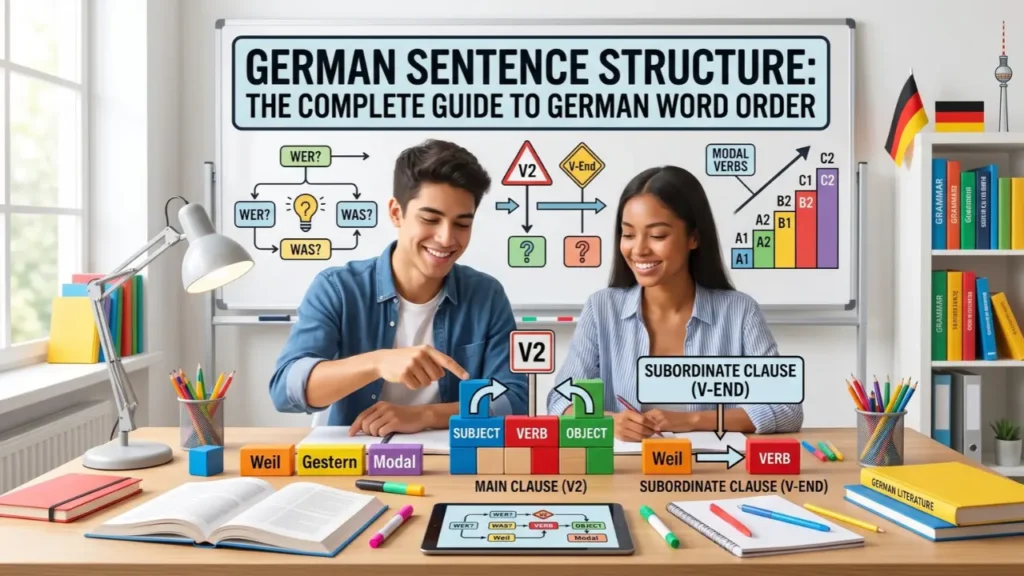
In a German main clause, the conjugated verb is always the second element. Not the second word. The second element, which can be one word
Yes, you can learn German by yourself from B1 to B2. Two real, independently sourced estimates put the additional hours needed somewhere between 250 and
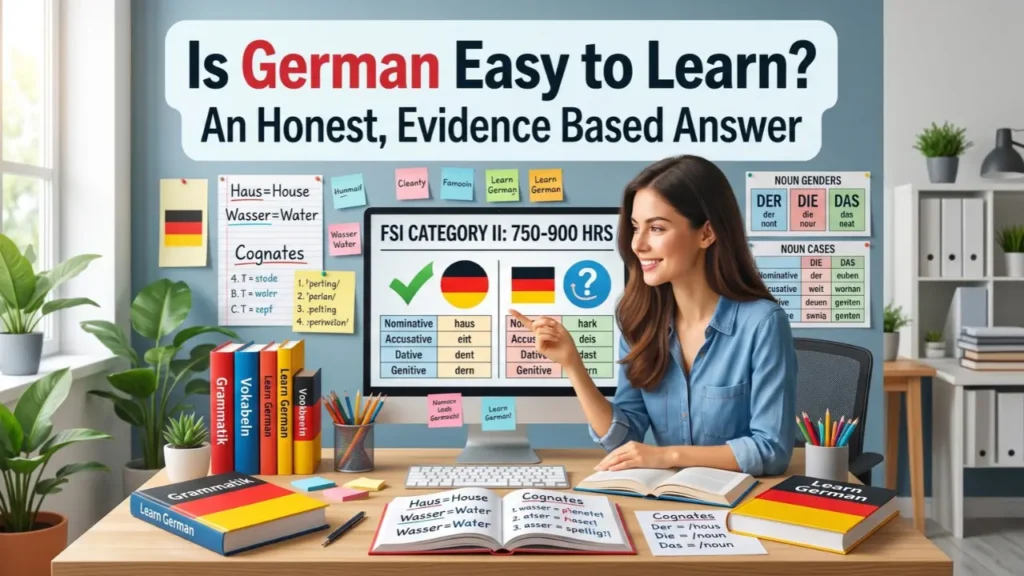
Is German easy to learn? The honest answer is that German is moderately difficult, not effortless, but far more manageable than its reputation suggests. The