
Basic German Grammar: A Complete Beginner’s Guide to the Rules
Basic German grammar is built from a small number of core rules. Noun gender, four grammatical cases, verb conjugation, and a fixed verb position in



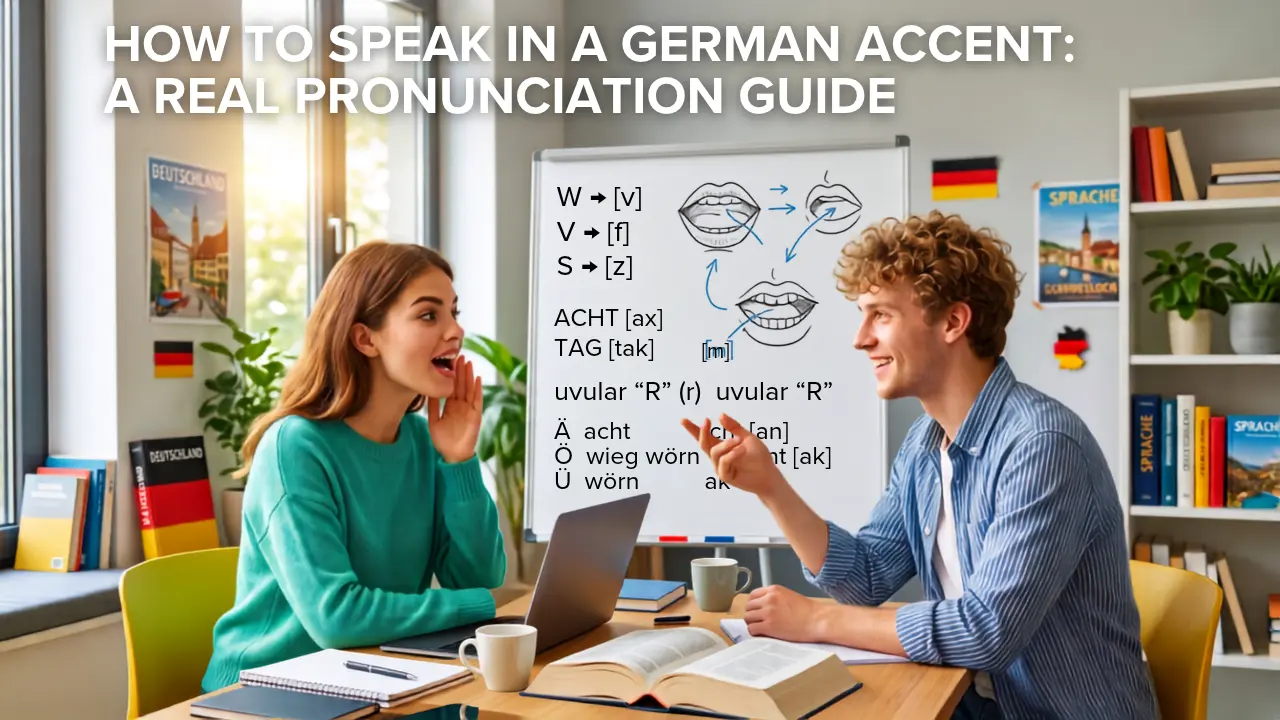
Learning how to speak in a German accent comes down to a small, learnable set of sound shifts. The consonants change in predictable ways, the vowels shift position in your mouth, and the German R works completely differently from the English R. Getting understood matters more than sounding fully native, and both goals are achievable with focused, consistent practice.
| English sound | German accent shift | Example |
|---|---|---|
| W | Becomes V | Wasser sounds like “Vasser” |
| V | Becomes F | Vater sounds like “Fater” |
| S (start or middle of word) | Becomes Z | Sonne sounds like “Zonne” |
| R | Voiced from the back of the throat | Rot, not an English R |
| Word final G, D, B | Harden to K, T, P | Tag sounds like “Tak” |
| Umlauts (ä, ö, ü) | New vowel sounds, no English equivalent | Schön, müde, Bär |
You need to be understood, not native sounding, and those are genuinely different goals. Most native German speakers care whether they can follow you easily, not whether your accent is perfect. Working on the specific sounds covered in this guide gets you understood quickly. Sounding fully native, if you want that too, generally takes years of immersion on top of that.
A German accent is built from a handful of consistent, learnable rules rather than hundreds of random exceptions. Once you learn these core shifts, you can apply them to almost any German word, even ones you have never heard before, since German spelling maps to sound far more predictably than English does.
The core shifts every learner needs are:
Each of these gets its own full explanation below, with real words to practice, and together they answer the full question of how to speak in a German accent from the ground up.
There is no English style W sound in German. Every W is pronounced like an English V.
The letter V, in turn, is usually pronounced like an English F, not like an English V.
There is a real exception worth knowing. In loanwords borrowed from other languages, V keeps its English sounding V pronunciation.
German S behaves differently depending on where it sits in a word.
The letter Z works differently from English entirely. German Z is pronounced like the “ts” sound at the start of “tsunami,” never like an English Z.
The German R does not exist in English, and it is one of the most recognizable features of a German accent. It is pronounced as a voiced sound from the back of the throat, technically called a voiced uvular fricative, not rolled on the tip of the tongue the way a Spanish or Italian R is.
A simple way to practice it: gently gargle without any liquid in your mouth. That soft vibration at the back of your throat is close to the correct starting point for the German R.
At the end of a word or syllable, the German R often softens into something closer to a vowel sound, an “uh” or “ah,” rather than a full consonant. Der (the, masculine) is a common example of this softened final R.
Understanding this rule is essential to how to speak in a German accent convincingly, since it appears in an enormous number of common words. This is one of the most consistent, genuinely useful rules in German pronunciation, and it has a real linguistic name, Auslautverhärtung, meaning final devoicing. At the end of a word, the “soft” consonants G, D, and B harden into their “hard” counterparts K, T, and P.
| Word ending in | Sounds like | Example |
|---|---|---|
| G | K | Tag (day) sounds like “Tak” |
| D | T | und (and) sounds like “unt” |
| B | P | Lieb (dear) sounds like “leep” |
This same rule connects directly to the S ending rule covered earlier. Both are examples of German softening or hardening sounds specifically at the end of a word, not because the letters themselves changed, but because German consistently devoices consonants in the final position of a word or syllable. Once you see these as one connected pattern rather than several separate rules, word endings become far easier to predict.
German has three umlauted vowels, ä, ö, and ü, none of which have a true English equivalent. Each one also has a short and a long version.
Typing these characters is simpler than it looks. On a Mac, hold Option and U, then type the letter you want an umlaut over. On Windows, hold Alt and type 0228 for ä, 0246 for ö, or 0252 for ü.
The character ß, called Eszett or scharfes S, is pronounced exactly like a regular English S. It is simply another way of writing a double S, and it never appears at the start of a word or in all capital letters, where it gets replaced by ss instead. Straße (street) and groß (big) both use this sound, identical to the S in “sorrow.”
German vowels are either short or long, and the difference genuinely changes a word’s meaning, not just its sound. A few real patterns make this predictable.
German word stress also follows a reliable pattern. Most native German words place stress on the first syllable, unlike English, which shifts stress more unpredictably across different words.
Practicing real, high frequency vocabulary is far more useful than practicing isolated sounds alone, and it is the fastest way to actually apply everything covered so far about how to speak in a German accent. Numbers are an especially good starting point, since they combine several of the sound shifts above in short, memorable words.
| Number | German | Sound shift practiced |
|---|---|---|
| One | eins | Vowel length |
| Two | zwei | Z as “ts” |
| Three | drei | R sound |
| Four | vier | V as F |
| Five | fünf | Ü sound |
| Six | sechs | Standard consonants |
| Seven | sieben | S as Z |
| Eight | acht | CH sound |
| Nine | neun | Diphthong |
| Ten | zehn | Z as “ts,” long E |
Once single words feel comfortable, move on to short, common phrases, since real conversational rhythm is different from reading isolated words aloud.
Once you understand how to speak in a German accent using the sound shifts above, reducing your English accent becomes a matter of consistent practice, not guesswork. You can significantly reduce it, though completely eliminating it is genuinely rare without years of immersion. Most learners who focus consistently on the R sound, vowel length, and the W and V shift see real, noticeable improvement within a few months, often enough to be mistaken for a near native speaker in everyday conversation.
It is possible but uncommon, and it generally requires sustained immersion, real phonetic training, and years of consistent practice, not just vocabulary study. For nearly all learners, a strong, clearly understandable accent is a realistic and genuinely sufficient goal. Full native pronunciation is a bonus, not a requirement for real fluency.
This usually happens because your accent signals non native status before your German has a real chance to prove itself, not because your German is actually wrong. Many German speakers switch to English automatically, out of habit or simple efficiency, even when a learner’s grammar is completely correct.
A few practical ways to keep the conversation in German:
Continuing to practice the specific sounds in this guide is also the most effective long term way to change that automatic response, since a stronger accent naturally reduces how often this happens in the first place.
Standard German, called Hochdeutsch, is the version taught in schools and used in most media, and it is the genuinely safe, reliable target when learning how to speak in a German accent as a foreign learner. Real regional variation does exist, though, and it is worth knowing about even if you are not trying to master it.
As a learner, sticking with standard Hochdeutsch pronunciation is the right choice. Native speakers are used to hearing many different accents and regional variations every day, so there is no need to worry about matching one specific region.
Some readers are here for a different reason entirely, portraying a German character in acting, comedy, or performance rather than learning to speak German as a language learner. That version of a German accent is a simplified, exaggerated set of the same sound shifts covered above, mainly the W to V shift and the harder consonants, applied to English words rather than German ones. If that is your goal, the core sound shift table near the top of this guide is genuinely the fastest starting point, just apply the same shifts to English words instead of German ones.
There is no single fixed timeline for how to speak in a German accent naturally, since it depends heavily on practice consistency and real speaking exposure. Most consistent learners notice a real, clear improvement in their accent within two to three months of focused practice, and a genuinely comfortable, understandable accent within six months to a year. Full comfort with every sound, including the R and the umlauts in fast, natural speech, generally takes longer and depends heavily on real speaking practice with native speakers, not just study or listening alone.
Even learners who understand the rules for how to speak in a German accent in theory tend to repeat the same handful of mistakes in real conversation.
Start with the core consonant shifts, W to V, V to F, and S to Z, since these appear constantly in everyday German, then move on to the R sound and the umlauts once those feel automatic. This same order is the most efficient path to learning how to speak in a German accent overall.
Most English speakers find the German R the hardest part of how to speak in a German accent, since it is produced from the back of the throat and has no real equivalent in English.
The large majority do, since German spelling is highly phonetic and consistent, though loanwords like Vase and Video keep pronunciation closer to their original language.
German pronunciation is actually more consistent and predictable than English, since German spelling reliably signals sound, while English is full of exceptions.
According to the Standard German phonology entry on Wikipedia, standard spoken German follows a documented, de facto pronunciation standard, closest to the accent associated with Hanover, rather than being defined by any single official spelling based rule, which is exactly why consistent practice against real, standard audio matters more than memorizing spelling alone.
This guide covered every core piece of how to speak in a German accent, from the consonant shifts through the R sound, word final devoicing, and the umlauts. Reading through these rules is a genuinely strong starting point for how to speak in a German accent with real confidence. Producing them correctly, in real time, during an actual conversation, is a different skill, one that comes from real, corrected speaking practice rather than reading alone. That gap is exactly what German Study Path’s live online German classes are built to close. Small groups capped at a fixed number, native teachers correcting your pronunciation as you speak, across every level from A1 through C2, backed by a money back guarantee.
Basic German grammar is built from a small number of core rules. Noun gender, four grammatical cases, verb conjugation, and a fixed verb position in

Yes, for the course itself. Independent sources confirm online German classes typically run 10 to 20 percent cheaper than offline classroom training in India, since

Yes, you can learn German by yourself from B1 to B2. Two real, independently sourced estimates put the additional hours needed somewhere between 250 and

In a German main clause, the conjugated verb is always the second element. Not the second word. The second element, which can be one word