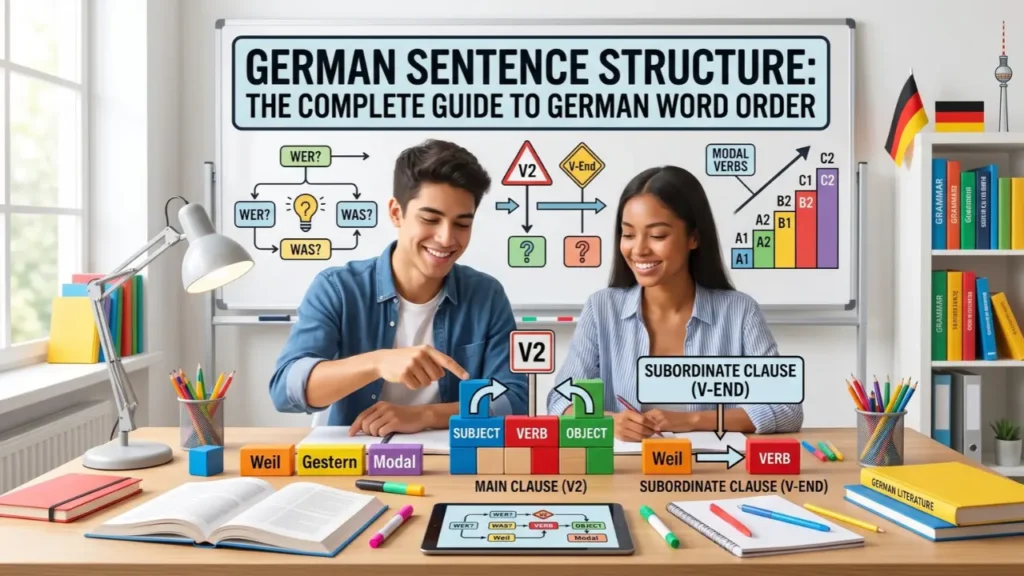
German Sentence Structure: The Complete Guide to German Word Order
In a German main clause, the conjugated verb is always the second element. Not the second word. The second element, which can be one word



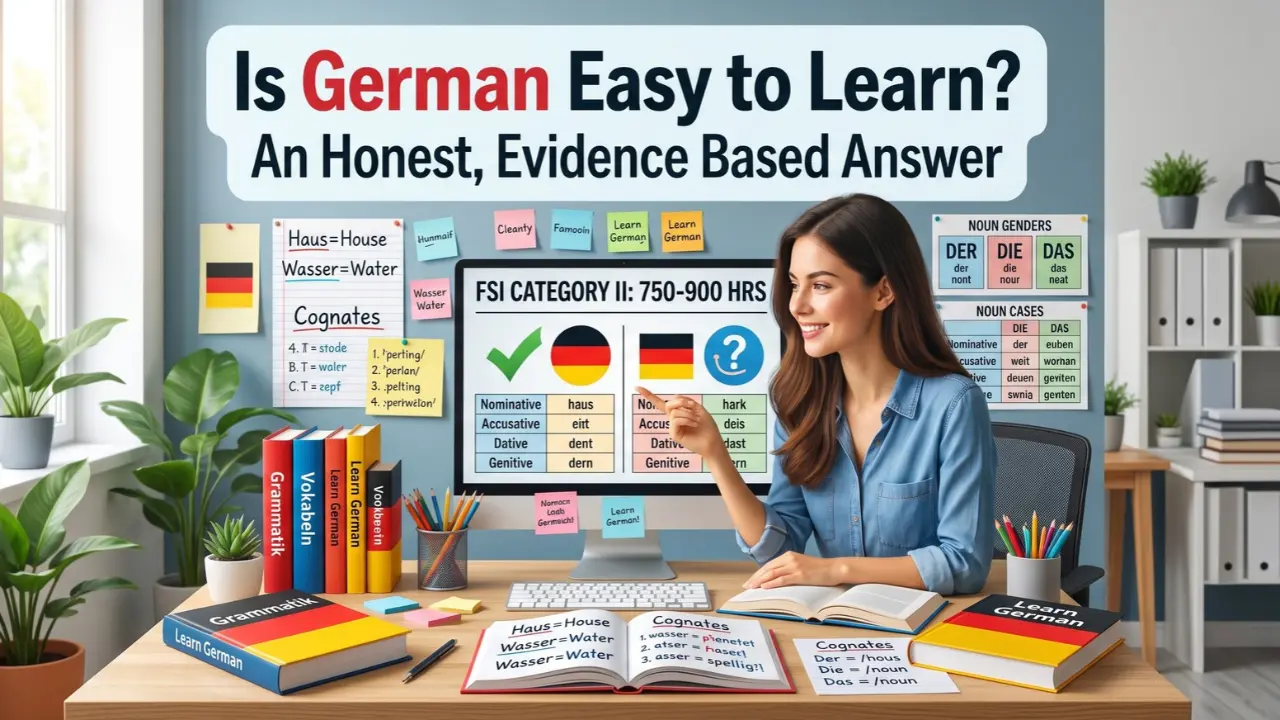
Is German easy to learn? The honest answer is that German is moderately difficult, not effortless, but far more manageable than its reputation suggests. The United States Foreign Service Institute, the agency that trains American diplomats in foreign languages, classifies German as a Category II language. That means it typically takes 750 to 900 classroom hours to reach professional working fluency, more than Spanish or French, but far less than languages like Arabic, Japanese, or Mandarin.
Is German an easy language to learn compared to others in general terms. It is one of the more approachable options if your goal is Europe, business, or academic study, though it is not among the very easiest languages for an English speaker to pick up. This guide gives you the real, balanced picture. Not a sales pitch that says German is effortless, and not a scary list of everything that makes it hard. Just the honest facts, backed by real sources, so you know exactly what you are getting into.
| Factor | What the data shows |
|---|---|
| FSI difficulty category | Category II out of IV |
| Estimated study hours | 750 to 900 hours |
| Vocabulary overlap with English | 40 to 60 percent, thanks to shared Germanic roots |
| Pronunciation | Mostly phonetic, words sound like they are spelled |
| Grammar | Logical and consistent, but includes four cases and three genders |
| Time to basic conversation | About 6 months of consistent study |
| Time to professional fluency | Roughly 2 to 3 years |
Both, depending on which part of the language you are looking at. Is German hard to learn? In some ways, yes. The grammar includes features English does not have, like grammatical gender and four noun cases. Is German easy to learn? In other ways, also yes. The pronunciation is far more predictable than English, and a large share of German vocabulary will already look familiar to English speakers.
Language difficulty is not really one single number. It depends on your native language, how much time you put in, and whether you get real speaking practice, not just app based drills. Whether you are asking is German easy to learn out of curiosity or because you are actually planning to start, what follows is the actual data behind that answer, not just an opinion.
The Foreign Service Institute groups the world’s languages into four categories based on how long it takes an English speaking adult to reach professional working proficiency.
| Category | Estimated hours | Example languages |
|---|---|---|
| Category I | 600 to 750 hours | Spanish, French, Italian, Dutch |
| Category II | 750 to 900 hours | German, Indonesian, Swahili |
| Category III | Around 1,100 hours | Russian, Hindi, Turkish, Vietnamese |
| Category IV | 2,200 hours or more | Arabic, Japanese, Mandarin, Korean |
German sits at Category II, which places it closer to the easy end of the scale than most people assume. It takes more time than Spanish or French, roughly 150 extra hours, but it is nowhere near as demanding as Category III or Category IV languages. This single fact answers the core question, is German easy to learn, better than any general impression or online myth. German is a real, measurable step up from Spanish in difficulty, not a leap into a completely different tier.
Yes, more than most learners expect. English and German are both West Germanic languages, part of the same Indo-European language family, so they share a real common ancestor. That shared history shows up directly in vocabulary. Around 40 to 60 percent of German words have a recognizable English cognate, a word that looks or sounds similar and means the same thing.
Haus means house. Wasser means water. Freund means friend. Garten means garden. These are not coincidences, they come from the same linguistic root. This overlap gives English speakers a genuine head start that speakers of unrelated language families simply do not have.
Is German hard to learn for English speakers specifically? The honest answer is that English speakers face an easier vocabulary curve but still need real effort on grammar, since English lost most of its case system centuries ago and German kept it. Shared vocabulary shortens one part of the learning curve. It does not remove the need to learn German’s grammar rules from scratch.
Several real features of German make it more approachable than its reputation suggests.
A fair, honest answer also means naming the real challenges directly, not glossing over them.
Is German difficult to learn because of these features specifically, or is the reputation overblown? The honest answer sits in the middle. Gender, cases, compound words, and clause final verbs are all real, well documented challenges, confirmed by nearly every serious source on the topic. But none of them make German impossible, and all of them follow learnable, consistent rules rather than the kind of scattered, memorize each case individually exceptions that make some languages genuinely unpredictable. Difficulty here means more rules to learn, not more chaos to survive.
Difficulty always makes more sense in context. German sits solidly in the middle of the real difficulty scale, harder than the most closely related European languages, but easier than languages from entirely unrelated language families.
Any honest german vs spanish language comparison has to start with the same official source used throughout this guide. Spanish is genuinely easier for most English speakers to pick up quickly, and the FSI data backs this up directly, Spanish sits in Category I at 600 to 750 hours, while German sits in Category II at 750 to 900 hours. Spanish pronunciation and grammar are more regular in some respects, and Spanish does not use a case system the way German does.
But German has its own real advantages. German shares more vocabulary directly with English than Spanish does, since German and English are both Germanic languages, while Spanish is a Romance language descended from Latin. German is also more consistently phonetic than Spanish in certain respects, particularly around vowel sounds. Neither language is simply better or worse. Spanish is faster to reach conversational comfort. German rewards the extra effort with grammar that, once learned, applies with fewer exceptions.
So is German or Spanish easier to learn overall? For pure speed to conversational ability, Spanish generally wins. For long term grammar consistency and vocabulary overlap with English, German holds its own. The right choice usually comes down to which country, culture, or career path actually motivates you to keep studying, since consistency matters more than the small gap in official difficulty hours between the two.
Is German easy to learn for Indian students specifically, given how different Indian languages are from German in structure and vocabulary.
This is a genuinely common and reasonable question, and the honest answer depends less on your native Indian language and more on your existing English proficiency. For most Indian learners, English serves as the real bridge to German, since German and English share so much vocabulary and some basic grammatical structure. A strong English foundation generally makes German noticeably more approachable, regardless of whether your first language is Hindi, Tamil, Bengali, or any other Indian language.
One myth worth correcting directly. German is not derived from Sanskrit. Both languages do belong to the same broad Indo-European language family, so they share a distant common ancestor, but German comes from the Germanic branch of that family, while Sanskrit comes from the Indo-Aryan branch. They are, at most, distant linguistic cousins, not parent and child.
For Indian learners with limited English exposure, German will likely feel more challenging at first, simply because the vocabulary bridge that helps English speakers is weaker. This is not a reflection of ability. It simply means building English vocabulary alongside German, or leaning more heavily on structured grammar instruction, tends to help.
Difficulty is never the same for every learner, and being honest about this matters. Several real factors change how German actually feels.
Difficulty is not the same at every level. Here is what genuinely changes as you move through the CEFR framework, the standard scale used to measure language proficiency.
Is the German language easy to learn at every one of these stages equally? No, and that is worth saying plainly. Most learners find A1 and A2 genuinely approachable, B1 noticeably harder, and B2 through C2 a matter of steady refinement rather than new, overwhelming difficulty. Knowing this in advance helps set realistic expectations instead of assuming the language gets uniformly harder the further you go.
Realistic timelines matter more than an abstract difficulty rating. Most consistent learners reach everyday conversational ability, enough to order food, make small talk, and handle simple daily situations, within about 6 months of regular study. Reaching professional fluency, generally understood to require a vocabulary of around 10,000 words along with strong grammar control, typically takes 2 to 3 years of sustained effort.
These numbers line up closely with the FSI’s 750 to 900 hour estimate. If you study for roughly 10 hours a week, that estimate translates to somewhere between a year and a half and two years of consistent, focused practice to reach strong professional level fluency.
Searching is German easy to learn online will turn up plenty of confident opinions, but the FSI data, the real cognate percentages, and the CEFR level breakdown above are the actual evidence behind this guide’s answer, not guesswork.
These tips will not change the official difficulty rating, but they genuinely change how easy German feels day to day.
Pay attention to the difference between recognizing German and producing it. Being able to understand a word or sentence when you read or hear it is a different skill from being able to generate it correctly yourself in conversation. Many self study methods build strong recognition but leave production skills undertrained, which is often the real reason learners feel stuck despite months of study.
Break every long compound word into its smaller parts the moment you encounter it. Handschuh, glove, breaks down into Hand plus Schuh, hand plus shoe, an old but genuinely memorable image. This same technique works for nearly every long German word you will come across.
Learn the gender of every new noun at the same time as the word itself, not afterward. Treating der, die, and das as part of the word from day one builds the habit faster than trying to memorize genders separately later.
Focus on speaking from the earliest stage possible, not just vocabulary memorization. Reading and app based drills build recognition, but real comfort with cases, gender, and word order comes from producing the language yourself and getting corrected in real time.
Use mnemonic devices for anything that feels arbitrary. A short phrase or image tied to a case ending, a gender, or a tricky irregular verb sticks far better in memory than repetition alone.
Set realistic weekly goals instead of relying on motivation alone. Learners who study for a fixed amount of time several days a week consistently outperform learners who study intensely for a few days, then stop for weeks. Language learning research on retention shows spaced, repeated practice beats occasional cramming by a wide margin, regardless of which language is being studied.
Moderately, not effortlessly. The FSI classifies German as a Category II language, requiring 750 to 900 study hours, easier than most of the world’s languages, but more demanding than Spanish or French.
Yes, more than most learners expect. English and German share 40 to 60 percent vocabulary overlap through their common Germanic roots, giving English speakers a genuine head start.
It depends more on existing English proficiency than on any specific native Indian language, since English serves as the real linguistic bridge to German for most Indian learners.
German pronunciation is almost entirely phonetic, its grammar follows consistent and predictable patterns, and it uses only six verb tenses compared to English’s twelve.
Three grammatical genders assigned to nouns in ways that often feel arbitrary, four grammatical cases, long compound words, and a subordinate clause word order where the verb moves to the end of the sentence.
Both are moderately difficult for English speakers in different ways. French has more irregular verb conjugations and less predictable pronunciation. German has more grammatical complexity through cases and gender, but more consistent, phonetic spelling.
Most learners reach everyday conversational ability in about 6 months of consistent study. Professional fluency, around 10,000 words of vocabulary, typically takes 2 to 3 years.
Generally, yes, according to official classification. The FSI places Spanish in Category I, the easiest tier, and German in Category II, meaning German typically requires more study hours to reach the same proficiency level.
According to the Foreign Service Institute’s language difficulty rankings, German consistently falls into the second easiest of four difficulty tiers for native English speakers, a classification used by professional linguists and language trainers as a genuine, evidence based reference point.
So is German easy to learn, in the end. Moderately, honestly, and predictably, once you know what to expect at each stage. Knowing the real difficulty level of German is useful. Actually building the speaking confidence to use it is a different process, one that reading alone will not create. That gap is exactly what German Study Path’s live online German classes are built to close. Small groups capped at a fixed number, native teachers correcting your grammar and pronunciation as you speak, across every level from A1 through C2, backed by a money back guarantee.
In a German main clause, the conjugated verb is always the second element. Not the second word. The second element, which can be one word

Yes, you can learn German by yourself from B1 to B2. Two real, independently sourced estimates put the additional hours needed somewhere between 250 and

German is an official language in six countries and holds co-official or minority status in several more. Beyond that, deutsch language speaking countries and communities
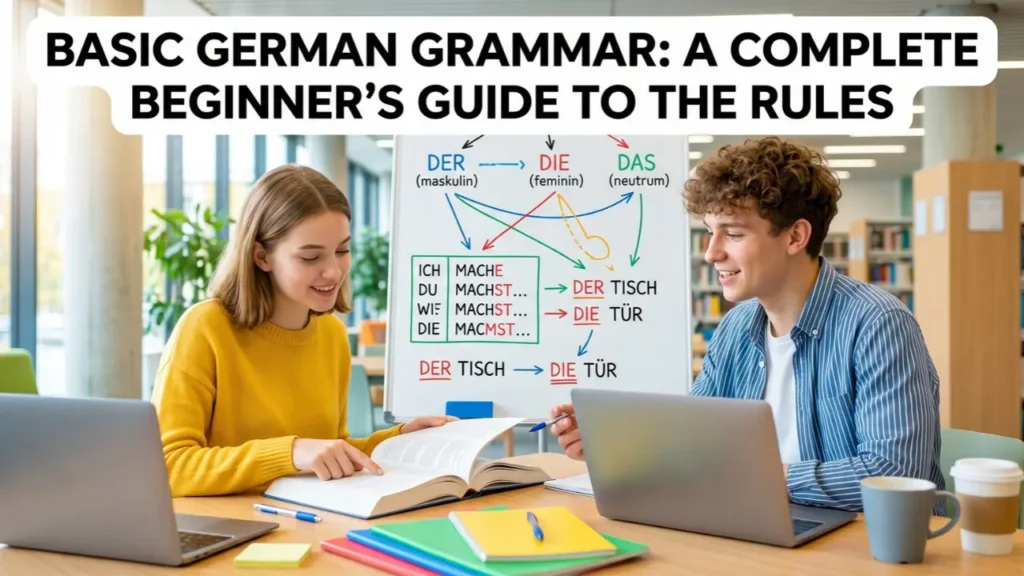
Basic German grammar is built from a small number of core rules. Noun gender, four grammatical cases, verb conjugation, and a fixed verb position in