
Is German Easy to Learn? An Honest, Evidence Based Answer
Is German easy to learn? The honest answer is that German is moderately difficult, not effortless, but far more manageable than its reputation suggests. The



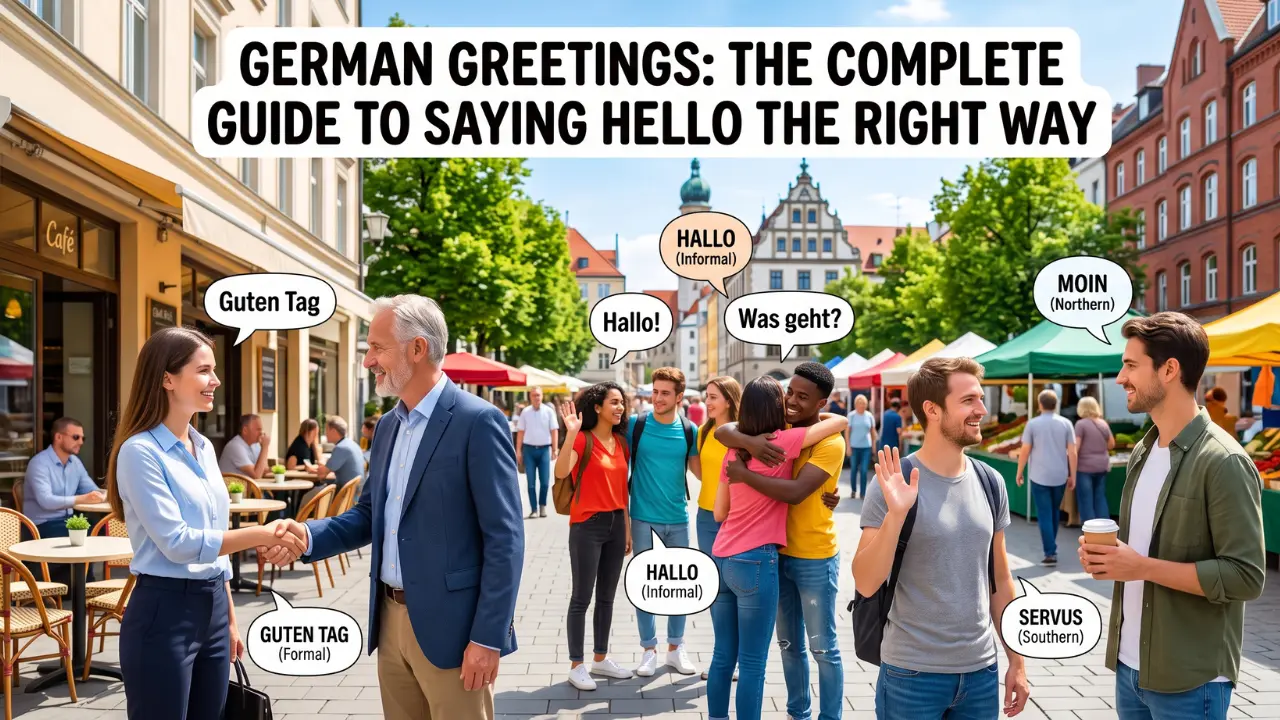
German greetings depend on two things above all else, formality and time of day. Get those two right and nearly every real conversation starts smoothly. Knowing how to greet in german confidently, whatever the setting, comes down to learning a small, manageable set of rules. This guide covers every real situation, formal, informal, regional, and how to pronounce each greeting correctly.
| German | English | Formality | When to use |
|---|---|---|---|
| Hallo | Hello | Informal | Anytime, with people you know |
| Guten Tag | Good day, hello | Formal | Daytime, with strangers or in professional settings |
| Guten Morgen | Good morning | Formal or informal | Before around 11am |
| Guten Abend | Good evening | Formal or informal | After around 6pm |
| Moin | Hi | Informal | Northern Germany, any time of day |
| Servus | Hi or bye | Informal | Bavaria and Austria |
German greetings are the fixed phrases used to say hello, and choosing the right one depends heavily on who you are speaking to. Unlike English, where “hi” works for almost everyone, German has a genuine formal and informal split baked directly into how people address each other. Using an informal greeting with a stranger, an older person, or a boss can come across as disrespectful, while using an overly formal greeting with a close friend can feel cold or distant. Getting this right matters more in German than in English, since the formality choice shows up in the greeting itself, not just in tone of voice.
Hallo is the single most common way to say hi in German, and it works in almost any casual situation. It is pronounced HAH-loh, with the stress on the first syllable. Hallo is genuinely flexible, you can use it with friends, family, coworkers you know well, or even strangers in relaxed settings like shops or cafes. It sits comfortably between formal and informal, which is exactly why it is usually the first greeting learners pick up.
Formal greetings in german are essential in professional settings, when meeting strangers, or when speaking with someone older than you. Knowing the right formal greeting german speakers expect in these situations makes a genuinely strong first impression.
There is a real grammar reason behind the word guten rather than simply gut. German adjectives take a specific ending based on the noun’s grammatical case, and Tag, Morgen, and Abend are all in the accusative case here, since the greeting is really a shortened form of a wish, something like “I wish you a good day.” That accusative case requires the -en ending, which is why it is guten Tag, not gut Tag.
Informal German greetings are used with friends, family, and people you already know well.
These greetings pair naturally with the informal du form of address, rather than the formal Sie, which is covered in detail in the next section.
Choosing between Sie and du is not just a grammar choice, it directly shapes which greeting sounds natural. German even has real verbs for this distinction, siezen means to address someone formally with Sie, and duzen means to address someone informally with du.
A few practical rules:
Guten Tag literally means good day, and it functions as the standard, all purpose formal hello in German. It is appropriate any time during the daytime, roughly from mid morning until early evening, and it works equally well for meeting a stranger, greeting a shopkeeper, or opening a business meeting. Guten Tag is genuinely one of the most useful phrases a beginner can learn, since it is polite, safe, and understood everywhere in the German speaking world.
Good afternoon in german and its morning and evening counterparts all shift with the time of day, and each one has a real, reasonably consistent window.
| Time of day | German greeting | Rough time window |
|---|---|---|
| Morning | Guten Morgen | Before 11am |
| Afternoon | Guten Tag | 11am to early evening |
| Evening | Guten Abend | Early evening onward |
| Night, farewell only | Gute Nacht | Only when leaving or going to bed |
Good night, Gute Nacht, is worth a special note, the same way good evening in germany itself deserves one. Unlike the other three, it is a farewell, not a greeting, used only when parting ways or heading to bed, never as a way to say hello. Time of day and formality greetings, along with the full breakdown of good morning and good afternoon phrasing, are covered here at the level most beginners need daily.
Wie geht’s is the most common informal way to ask how are you, and Wie geht es Ihnen is the formal version. A genuine range of natural responses exists beyond a simple gut.
After answering, it is polite to return the question with Und dir? (informal) or Und Ihnen? (formal), both meaning and you.
The standard german for greetings always starts with Hallo or Guten Tag, but real regional variation exists across the country and is worth recognizing, even if you stick with the standard ones yourself. A visitor asking for a typical greeting from germany overall will usually be pointed toward one of these two first, then introduced to the regional variety below.
As a learner, sticking with standard greetings like Hallo and Guten Tag is always a safe, correct choice. Native speakers are used to hearing many regional variations and will understand you easily either way.
Written salutations follow their own set of formal rules, separate from the spoken phrases covered earlier in this guide. German business and personal correspondence both follow fairly strict conventions, and getting the salutation right sets the tone for everything that follows in the message.
These salutations matter for job applications, official correspondence, and professional emails, situations where the wrong tone can genuinely affect how a message is received.
Learning how to greet in german properly involves more than words. Real, physical etiquette matters too.
When meeting someone for the first time, a simple handshake paired with Guten Tag or Hallo, depending on the setting, is always appropriate. Erring on the side of slightly too formal is a safe habit for any new learner, since native speakers rarely take offense at extra politeness, while an overly casual approach with the wrong person can genuinely create an awkward first impression.
Beyond everyday hellos, German has specific greetings for special occasions.
These occasion specific greetings are genuinely useful once you move beyond basic conversation and start building real relationships with German speakers.
Farewells in German vary by formality and context, just like hellos.
| German | English | Context |
|---|---|---|
| Auf Wiedersehen | Goodbye | Formal, in person |
| Tschüss | Bye | Informal |
| Auf Wiederhören | Goodbye | Formal, specifically on the phone |
| Bis bald | See you soon | General |
| Bis morgen | See you tomorrow | When you know you’ll meet again the next day |
| Bis später | See you later | Same day |
Auf Wiederhören deserves special attention, since it is used exclusively on the telephone, a small but genuinely useful distinction most learners never hear explained.
Hallo for informal situations, and Guten Tag, Guten Morgen, or Guten Abend depending on the time of day for formal situations, are the most common German greetings.
Hallo, Guten Tag, Wie geht’s, and Auf Wiedersehen cover the vast majority of everyday situations a beginner will encounter.
Common responses include Gut, danke, Nicht schlecht, and Ziemlich gut, followed by returning the question with Und dir or Und Ihnen.
Yes, it is generally considered impolite to launch straight into a question or request without a greeting first, even with strangers like shopkeepers or clerks.
Hallo works well informally, but in clearly formal settings, meeting an older person, a stranger in a professional context, or a business contact, Guten Tag is the safer, more respectful choice.
According to Ethnic Communities New Zealand, a New Zealand government resource, the core formal and informal German greetings covered in this guide, including Guten Tag and Hallo, remain the standard, most widely understood options across German speaking communities today.
Learning the right phrases for every situation is a strong first step. Using them naturally, without pausing to think through the formality rules mid conversation, is a different skill, one that comes from real, corrected speaking practice. That gap is exactly what German Study Path’s live online German classes are built to close. Small groups capped at a fixed number, native teachers correcting your tone and formality as you speak, across every level from A1 through C2, backed by a money back guarantee.
Is German easy to learn? The honest answer is that German is moderately difficult, not effortless, but far more manageable than its reputation suggests. The

Yes, for the course itself. Independent sources confirm online German classes typically run 10 to 20 percent cheaper than offline classroom training in India, since
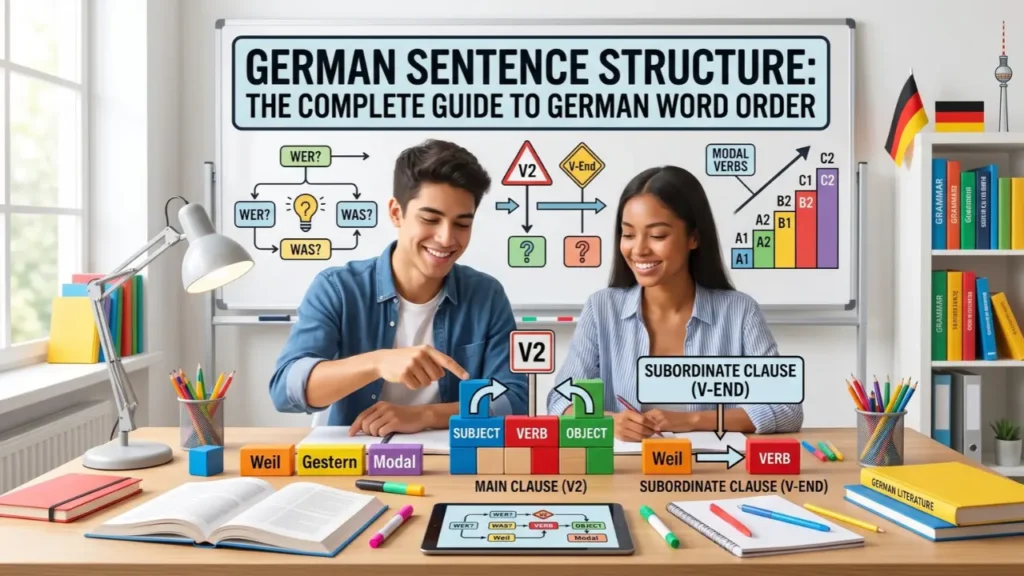
In a German main clause, the conjugated verb is always the second element. Not the second word. The second element, which can be one word

Basic German grammar is built from a small number of core rules. Noun gender, four grammatical cases, verb conjugation, and a fixed verb position in