
German Greetings: The Complete Guide to Saying Hello the Right Way
German greetings depend on two things above all else, formality and time of day. Get those two right and nearly every real conversation starts smoothly.




Basic German grammar is built from a small number of core rules. Noun gender, four grammatical cases, verb conjugation, and a fixed verb position in the sentence. Once you learn how these pieces work together, the rest of German grammar builds on the same logic. This guide covers the full range of german grammar basics in plain language, with real examples you can actually use.
| Grammar element | What it does |
|---|---|
| Noun gender | Every noun is masculine, feminine, or neuter |
| Four cases | Nominative, accusative, dative, genitive, they show a word’s role in the sentence |
| Verb conjugation | Verb endings change based on the subject |
| Word order | The verb holds a fixed second position in main clauses |
| Negation | Nicht or kein, depending on what is being negated |
| Plurals | Formed with several different endings, not just adding s |
German grammar works by marking a word’s role in a sentence through endings and articles rather than through position alone. Nouns carry a gender. Articles and adjectives change to match that gender and the noun’s grammatical case. The verb holds a fixed position in the sentence no matter what else moves around it. Once you see these three pieces working together, gender, case, and verb position, the rest of basic German grammar starts to feel like one connected system rather than a random list of rules.
Every beginner needs to learn the same core set of german language grammar basics to build real sentences. Nouns and their gender come first, since gender affects almost everything else in a sentence. The four cases come next, since they determine which form of an article or pronoun to use. Verb conjugation follows, since a verb’s ending changes based on who is doing the action. Plurals, negation, and basic word order round out what most learners need for genuine beginner level communication, the real german basics that every course builds on. Each of these gets its own clear explanation below, with real examples, not just isolated phrases to memorize.
Skipping basic German grammar and jumping straight into advanced vocabulary or complex conversation usually backfires. Without a working grasp of gender, case, and verb conjugation, learners end up guessing at sentence structure instead of building it correctly, which slows down real progress later. Investing time in basic German grammar early, even if it feels slower at first, makes every stage after A1 noticeably easier, since cases, adjective endings, and word order all lean directly on the same foundation covered in this guide.
This is one of the easiest German grammar rules to learn, and one that most guides barely mention. Every German noun is capitalized, in the middle of a sentence, not just at the start. Das Haus (the house), die Straße (the street), and der Lehrer (the teacher) all keep their capital letter no matter where they sit in a sentence. This makes nouns genuinely easy to spot on the page, since capitalization alone tells you a word is a noun, something English spelling never does.
Every German noun has a grammatical gender, masculine, feminine, or neuter, shown by its definite article. Der marks masculine nouns, die marks feminine nouns, and das marks neuter nouns.
Der Tisch, the table, is masculine. Die Tür, the door, is feminine. Das Fenster, the window, is neuter.
There is no reliable way to guess gender from meaning alone, a table has no real reason to be masculine. Some word endings do offer real hints. Nouns ending in -e are very often feminine, such as die Lampe. Nouns ending in -chen or -lein are always neuter, such as das Mädchen, the girl, an exception worth knowing since it looks like it should be feminine. Beyond these patterns, most learners simply memorize the gender alongside each new word, ideally from the very first time they learn it.
German uses four grammatical cases to show a noun’s role in a sentence. Each case changes the noun’s article, and sometimes its ending.
| Case | Role in the sentence | Example |
|---|---|---|
| Nominative | The subject, who or what is doing the action | Der Mann liest. (The man reads.) |
| Accusative | The direct object, who or what receives the action | Ich sehe den Mann. (I see the man.) |
| Dative | The indirect object, usually the person something is given or done to | Ich gebe dem Mann das Buch. (I give the man the book.) |
| Genitive | Possession, showing ownership | Das Auto des Mannes. (The man’s car.) |
Notice how der becomes den in the accusative, then dem in the dative, and des in the genitive. This is the real mechanical heart of German cases, the same noun keeps its meaning while its article changes to show its grammatical job. This introduction covers the core idea, and it is a genuinely solid german grammar for beginners starting point. A full breakdown of every case ending and every exception is a large enough topic to deserve its own dedicated guide.
Many German prepositions require a specific case, and this is a genuinely important basic grammar rule that beginners need early. Prepositions like durch (through), für (for), and ohne (without) always take the accusative case. Prepositions like aus (from), bei (at, near), mit (with), and zu (to) always take the dative case.
A smaller group, called two way prepositions, can take either case depending on meaning. In (in, into) takes the accusative when there is movement into a place, and the dative when describing a fixed location.
Ich gehe in die Küche. I am going into the kitchen, accusative, since there is movement toward the kitchen.
Ich bin in der Küche. I am in the kitchen, dative, since there is no movement, just location.
Learning which case each preposition takes, alongside the preposition itself, saves real time later, the same way learning noun gender alongside vocabulary does.
Regular German verbs follow a consistent pattern in the present tense, with endings that change based on the subject.
| Pronoun | Ending | Example, machen (to make) |
|---|---|---|
| ich (I) | -e | ich mache |
| du (you, informal) | -st | du machst |
| er, sie, es (he, she, it) | -t | er macht |
| wir (we) | -en | wir machen |
| ihr (you, plural informal) | -t | ihr macht |
| sie, Sie (they, you formal) | -en | sie machen |
Irregular verbs follow this same basic ending pattern but change their vowel in the du and er, sie, es forms. Sprechen (to speak) becomes du sprichst and er spricht, with the e shifting to an i. These vowel shifts have to be learned individually, but they only affect a limited, learnable set of common verbs, not the whole language.
Unlike English, German does not form most plurals by simply adding an s. Instead, German uses several different plural endings, and sometimes an umlaut, depending on the noun.
Many nouns add -e, sometimes with an umlaut. Der Hund becomes die Hunde (dogs).
Many single syllable neuter nouns add -er, often with an umlaut. Das Haus becomes die Häuser (houses).
Many feminine nouns add -en or -n. Die Blume becomes die Blumen (flowers).
Words borrowed from other languages often simply add -s. Das Auto becomes die Autos (cars).
Some nouns do not change at all in the plural, only the article shifts. Der Lehrer becomes die Lehrer (teachers).
There is no single universal rule, but these five patterns cover the large majority of German nouns, and the ending of a noun in its singular form is usually a reliable clue to which pattern it follows. This is one of the more mechanical parts of basic deutsch grammar, and it becomes far more predictable with practice.
This is one of the trickier parts of basic German grammar, and it deserves a full explanation, not just a few example phrases. Adjective endings change based on three things at once, the noun’s gender, its case, and whether the noun is preceded by a definite article, an indefinite article, or no article at all.
When a definite article (der, die, das) comes before the adjective, the adjective itself usually takes a simple -e or -en ending, since the article already shows the gender and case. Der kleine Hund, the small dog.
When an indefinite article (ein, eine) comes before the adjective, the adjective has to carry more information itself, since ein does not show gender as clearly as der, die, das does. Ein kleiner Hund, a small dog, the adjective ending changes to -er here specifically because the masculine nominative article ein does not signal gender on its own.
When there is no article at all, the adjective takes the strongest ending, essentially standing in for the missing article’s information. Kleiner Hund, small dog, spoken without any article.
The underlying logic is consistent even though it looks complicated at first. The sentence needs gender and case information conveyed somewhere, and the adjective ending fills in whatever the article does not already show.
German splits negation between two different words, and choosing the right one is a genuine, common beginner mistake. Kein negates a noun that would otherwise take ein or no article at all. Nicht negates everything else, verbs, adjectives, and nouns that already have a definite article.
Ich habe kein Auto. I do not have a car, since Auto would normally take ein.
Ich kaufe das Auto nicht. I am not buying the car, since das Auto is definite.
Ich verstehe das nicht. I do not understand that.
A simple way to remember the split, if the noun would use ein or no article, use kein. For everything else, verbs, definite nouns, adjectives, use nicht. This single distinction is one of the most practical grammar rules in german to learn early, since it comes up in almost every conversation.
Personal pronouns replace nouns and change form based on case, the same way articles do. Ich (I) becomes mich in the accusative and mir in the dative. Er (he) becomes ihn in the accusative and ihm in the dative.
Ich sehe ihn. I see him, accusative.
Ich gebe ihm das Buch. I give him the book, dative.
This same pattern of case based change also applies to possessive pronouns (mein, dein, sein) and reflexive pronouns (mich, dich, sich), both genuinely important german language grammar rules that build directly on the case system already covered above, each large enough topics to deserve their own deeper guide once you have this basic pattern down.
Basic German sentence structure places the conjugated verb in the second position of a main clause, no matter what comes first in the sentence. Word order shifts more than it does in English, a time word, an object, or a whole phrase can lead the sentence, but that one verb position rule almost never breaks. For the full breakdown, including subordinate clauses, questions, and modal verbs, see our complete guide to German sentence structure.
Most consistent learners can grasp the true basics, gender, the nominative and accusative cases, present tense conjugation, and simple word order, within a few months of regular study. Full comfort with all four cases, adjective endings, and more complex sentence patterns generally takes longer, closer to what the CEFR framework describes as A2 to B1 level ability. Progress through A1, A2, and into B1 reflects this same real timeline, each level building directly on the grammar covered in this guide.
In three months of consistent study, most learners can genuinely grasp the core basics covered in this guide, noun gender, the nominative and accusative cases, present tense verb conjugation, and simple sentence structure. Full comfort with all four cases and more advanced grammar generally takes longer, closer to six months to a year of regular practice, but the real foundation is achievable in three months with steady, focused effort.
Some learners try to skip formal grammar study entirely and rely purely on immersion, listening and reading without learning explicit rules. This approach can work over a long timeline, since it mirrors how children acquire their first language. But a basic grammar foundation, especially gender and cases, genuinely speeds up the process for adult learners and reduces the frustration of not understanding why a sentence is structured a certain way.
Even learners who understand basic German grammar in theory tend to repeat the same handful of mistakes in practice.
Guessing noun gender based on English logic or the object’s actual characteristics, rather than learning it directly alongside the word.
Using nicht where kein belongs, saying ich habe nicht ein Auto instead of the correct ich habe kein Auto.
Forgetting to capitalize nouns in the middle of a sentence, a small but real, easily fixed habit.
Applying English plural logic by adding an s to every noun, instead of learning the specific plural pattern for each word.
Skipping adjective endings entirely in casual speech, which is understandable at the very beginning but becomes a real accuracy problem by intermediate level.
A few habits make a genuine, measurable difference. Learn each noun’s gender at the same time as the word itself, never separately. Practice producing full sentences out loud, not just recognizing correct ones on a page. Focus on one grammar concept at a time instead of trying to absorb everything at once, and revisit each concept regularly rather than studying it once and moving on.
Once the basics feel steady, the fastest way to improve further is real conversation practice with correction, since reading and app based drills build recognition but not accurate production. Working through short, varied example sentences for each case and gender also helps the patterns become automatic, rather than something you consciously calculate every single time you speak.
Working through a few basic German grammar exercises right after reading is far more effective than reading alone, since producing an answer forces you to actually apply the rule instead of just recognizing it.
Fill in the correct article. ___ Hund ist braun. (Der, the dog is brown.)
Change the sentence to the accusative case. Der Mann liest das Buch becomes ich sehe ___ Mann.
Conjugate the verb correctly. Er (sprechen) Deutsch becomes er spricht Deutsch.
Choose nicht or kein. Ich habe ___ Zeit becomes ich habe keine Zeit.
Form the correct plural. Das Kind becomes die Kinder.
Every German noun has a grammatical gender, is always capitalized, and changes form across four cases. Verbs conjugate based on the subject, and the conjugated verb holds a fixed second position in main clauses.
German grammar has more rules than English, mainly gender and cases, but the rules themselves are consistent and logical once learned, unlike English’s many irregular exceptions.
German has four grammatical cases, nominative, accusative, dative, and genitive, each showing a different role a noun plays in a sentence.
Yes, every German noun is masculine, feminine, or neuter, shown by its definite article, der, die, or das.
Learning each noun’s gender alongside the word itself, practicing full sentences out loud, and focusing on one grammar concept at a time before moving to the next.
Start with noun gender and capitalization, since both appear in nearly every sentence, then move to the nominative and accusative cases and present tense verb conjugation before tackling adjective endings or the remaining cases.
According to Duden, the authoritative reference for the German language, German grammar is a rule governed system where case, gender, and verb position work together consistently, rather than being a set of arbitrary exceptions to memorize individually. That consistency is exactly what makes basic German grammar learnable in a genuinely predictable way once the core rules click into place.
This guide walked through the real basics of german language, gender, cases, verb conjugation, plurals, negation, adjective endings, and pronouns, the same core german basic grammar every learner needs before moving into more advanced material. Reading through these rules is the first real step toward genuine German ability. Producing them correctly, in real conversation, without stopping to calculate each ending, is a different skill, one that comes from real, corrected speaking practice rather than reading alone. That gap is exactly what German Study Path’s live online German classes are built to close. Small groups capped at a fixed number, native teachers correcting your grammar as you speak, across every level from A1 through C2, backed by a money back guarantee.
German greetings depend on two things above all else, formality and time of day. Get those two right and nearly every real conversation starts smoothly.
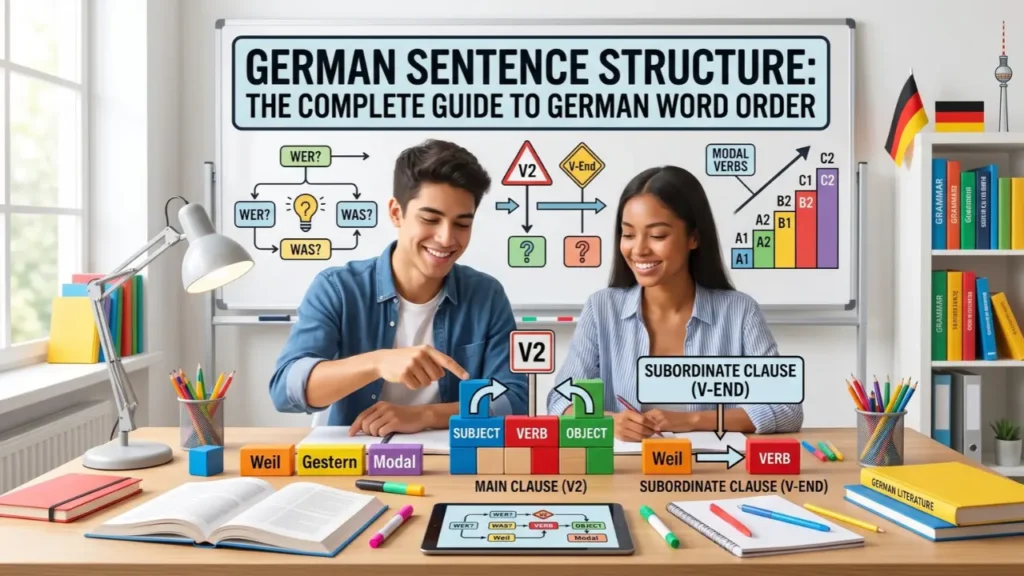
In a German main clause, the conjugated verb is always the second element. Not the second word. The second element, which can be one word
In a German main clause, the conjugated verb is always the second element. Not the second word. The second element, which can be one word

Basic German grammar is built from a small number of core rules. Noun gender, four grammatical cases, verb conjugation, and a fixed verb position in