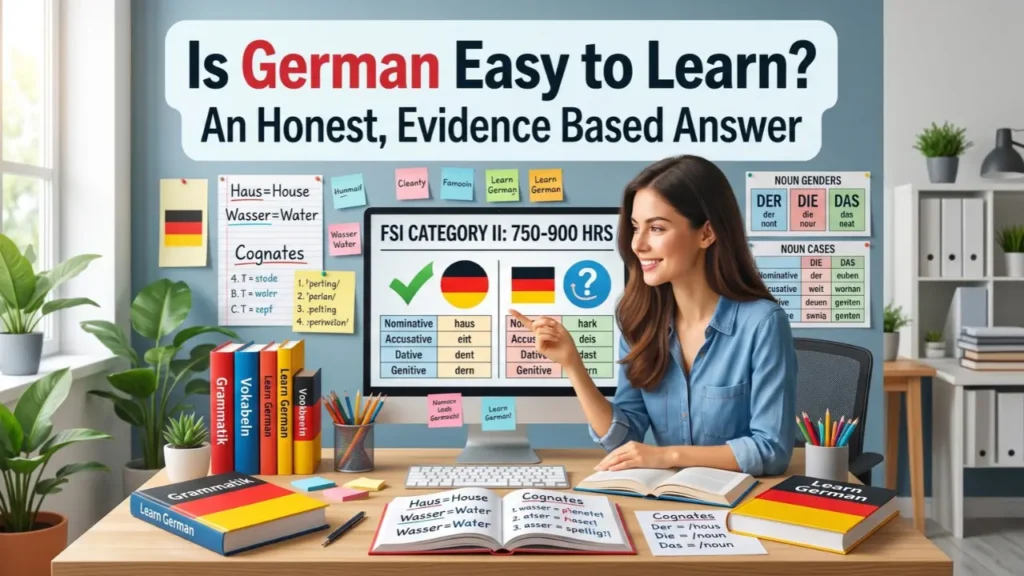
Is German Easy to Learn? An Honest, Evidence Based Answer
Is German easy to learn? The honest answer is that German is moderately difficult, not effortless, but far more manageable than its reputation suggests. The




Yes, for the course itself. Independent sources confirm online German classes typically run 10 to 20 percent cheaper than offline classroom training in India, since institutes save on rent, infrastructure, and in-person staffing. Understanding real german language course fees this way is the honest starting point most guides skip. But price is only half the real comparison. Once you factor in exam fees, and the much larger cost of actually relocating to study in Germany, the full picture looks different from what most fee guides show you.
German language course fees in India vary by level, institute, and format, but real, published ranges give a useful picture. If you have been searching for the fees of german language course options before committing, here is what the actual market looks like. Beginner level courses, A1 and A2, typically run 5,000 to 25,000 rupees. Intermediate levels, B1 and B2, generally cost 15,000 to 35,000 rupees. Advanced levels, C1 and C2, often run higher, 25,000 to 60,000 rupees, reflecting the extra instruction time and more specialized teaching these levels require. When comparing german course fees across institutes, always check whether the quoted number is per level or for the full A1 to C2 path, since some listings blend these together in a way that makes direct comparison difficult.
These figures follow the CEFR framework, the six level scale maintained by the Council of Europe and used by every recognized German course and exam body worldwide. A course priced for A1 is not comparable to one priced for C1, since the levels represent very different amounts of instruction time.
This is where a lot of confusion happens. Course fees, what you pay to attend classes, and exam fees, what you pay to sit a certification test, are entirely separate costs. Many articles list one number and imply it covers both.
Three exam bodies are widely recognized for German: the Goethe-Institut, telc, and the Österreichisches Sprachdiplom Deutsch, usually shortened to ÖSD. Goethe-Institut exam fees in India generally run 7,000 to 9,400 rupees for A1, around 10,600 rupees for A2, 12,000 to 18,800 rupees for B1, and around 21,200 rupees for B2, with C1 and C2 typically between 14,000 and 24,000 rupees. Telc B1 exam fees run around 199 euros in Germany, with India pricing depending on the specific partner institute administering it. ÖSD, developed in Austria and accepted across Austria, Germany, and Switzerland, follows a similar pattern of lower fees at beginner levels and higher fees as you move up the scale.
Every one of these exams tests the same four skills, reading, listening, writing, and speaking, and most centers let you register for the full exam or, in some cases, retake a single failed module rather than the whole test. Certificates from any of these three bodies are generally valid indefinitely, though some universities and immigration authorities prefer results from within the last two years.
Adding course fees and exam fees together gives you the real total cost. A learner going from A1 to B2, for example, should budget for both the cumulative course fees across four levels and four separate exam fees, not just one number.
Published fee ranges for the same level can differ by tens of thousands of rupees between institutes, and there are real, specific reasons why. Batch size matters, a smaller group with more individual speaking time generally costs more than a large lecture-style class. Trainer background matters too, native German speakers typically command higher fees than non-native instructors, though the gap in teaching quality can be significant. Course mode plays a role as well, online courses consistently price lower than offline ones due to lower institute overhead. Finally, whether an institute bundles in visa guidance, placement support, or exam registration assistance changes the price, since those services cost the institute time and staff regardless of whether you use them.
Understanding these factors matters more than chasing the lowest number you find, since a very cheap course with a large batch and no exam support may cost you more in the end if you need to repeat a level or retake an exam.
Both formats teach the same CEFR curriculum, but they differ in cost, flexibility, and daily logistics. If you are researching how to learn german language in india without committing to a fixed schedule, this is usually the first real decision to make. Offline classes mean commuting to a physical institute at fixed times, useful for some learners but a real time cost for anyone working full time or living outside a major city. Online classes remove the commute entirely and are confirmed to run 10 to 20 percent cheaper on average, since institutes are not paying for classroom space or in-person staff. Many learners specifically search to learn german online india once they realize how much time a daily commute actually costs them.
The tradeoff most guides skip over is quality, not just price. A live online class with a native teacher and a small group delivers the same real speaking correction as an in-person class. A recorded or self-paced online course does not, regardless of how cheap it is. When comparing options, the format that matters is live versus self-paced, not just online versus offline.
Every fee guide compares Indian institutes against each other. Almost none compare learning German from India against the realistic alternative many learners actually consider: traveling to Germany to study the language in person.
That alternative carries a cost most course-fee articles never mention. Non-EU students attending an in-person language program in Germany typically need a blocked bank account, currently required at just over 11,000 euros, roughly 10 lakh rupees, before a student visa is even granted. This is separate from tuition, travel, accommodation, and living costs. Learning online from India avoids this requirement entirely, since you are enrolling in a course, not applying for a study residence permit.
This does not mean online is always the right choice for every goal. If your plan requires being physically present in Germany regardless of language training, this comparison is less relevant. But if your goal is simply reaching a required German level, for a visa, a job, or Ausbildung, before you relocate, the cost difference between online learning and in-person study abroad is substantial, and worth knowing before you commit either way.
Rather than naming one best institute to learn german in india, which depends heavily on your city, schedule, and goals, the factors that actually determine value are consistent. Look for live instruction with a native or highly qualified teacher, not a purely self-paced recorded course. Check the actual group size, since a batch of 20 gives you far less speaking time than one capped at 10. Confirm whether course fees include a placement test, since starting at the wrong level wastes both time and money. And separate the course fee from any exam fee before comparing prices between institutes, since an apparently cheaper course may not include exam registration at all.
German language skills genuinely open real opportunities in India and abroad. Career after learning german language in india spans engineering, automotive, IT, and manufacturing, industries where German companies maintain a significant presence. For those planning to relocate, B1 is commonly required for Ausbildung, Germany’s vocational training system, and for basic visa categories, while B2 is the more common threshold for skilled employment and university admission. Job opportunities after learning german language in india include roles at German-affiliated companies, translation and interpretation work, and teaching positions, though specific salary outcomes depend heavily on role, location, and experience, and no course or certificate guarantees a particular job.
Total cost of learning german in india combines course fees, roughly 10,000 to 80,000 rupees online depending on level, and exam fees, roughly 7,000 to 24,000 rupees per level, treated as two separate expenses. Most guides only show one of these two numbers, which is why the total often surprises first time learners.
A1 course fees in India typically range from 5,000 to 25,000 rupees, with online courses generally at the lower end of that range. The cost of learning german language in india at this level is usually the most affordable entry point across every format.
German foundation course fees, usually covering A1, follow the same 5,000 to 25,000 rupee range as other A1 offerings, varying by institute and format.
Yes, for cost and flexibility, provided the course is genuinely live rather than self-paced. Online saves 10 to 20 percent on average without sacrificing instruction quality, as long as a real teacher is correcting your speaking each session.
Across all levels, published course fees in India typically fall between 10,000 and 150,000 rupees, with lower levels and online formats at the lower end.
Not to any certified level. Even intensive study, several hours daily, generally takes 4 to 6 months to reach basic conversational ability, and most working learners need longer with a realistic weekly schedule.
Beyond tuition, non-EU students typically need a blocked account of just over 11,000 euros to obtain a student visa for in-person study, a cost that does not apply when learning online from India.
Some public university programs taught in English have low or no tuition fees, but this refers to academic degree programs, not German language courses, which are a separate cost regardless of the teaching language.
Real German language course fees in India span a wide range for legitimate reasons, level, format, batch size, and whether exam support is included. Once you separate course costs from exam costs, and weigh online learning against the real expense of relocating to study abroad, the actual cheapest and most practical path usually becomes clear. Live, native taught courses, priced clearly from €299 to €339 with no separate registration fee, sit within the same range covered in this guide, without the guesswork of comparing institutes that quote course fees and exam fees together. If you want to see current pricing for a live, structured course by level, see our German Courses page for the full price list, our German language course in Delhi page for local pricing comparisons, or our German Language Course in India guide for the bigger picture on visas, work, and study paths.
Is German easy to learn? The honest answer is that German is moderately difficult, not effortless, but far more manageable than its reputation suggests. The

Yes, for the course itself. Independent sources confirm online German classes typically run 10 to 20 percent cheaper than offline classroom training in India, since

Learning how to speak in a German accent comes down to a small, learnable set of sound shifts. The consonants change in predictable ways, the

Yes, you can learn German by yourself from B1 to B2. Two real, independently sourced estimates put the additional hours needed somewhere between 250 and