How to Speak German Fluently: A Real, Evidence Based Guide
Fluency comes from a specific combination of real listening, active speaking, and consistency, not a single trick or app. This is the real, evidence based



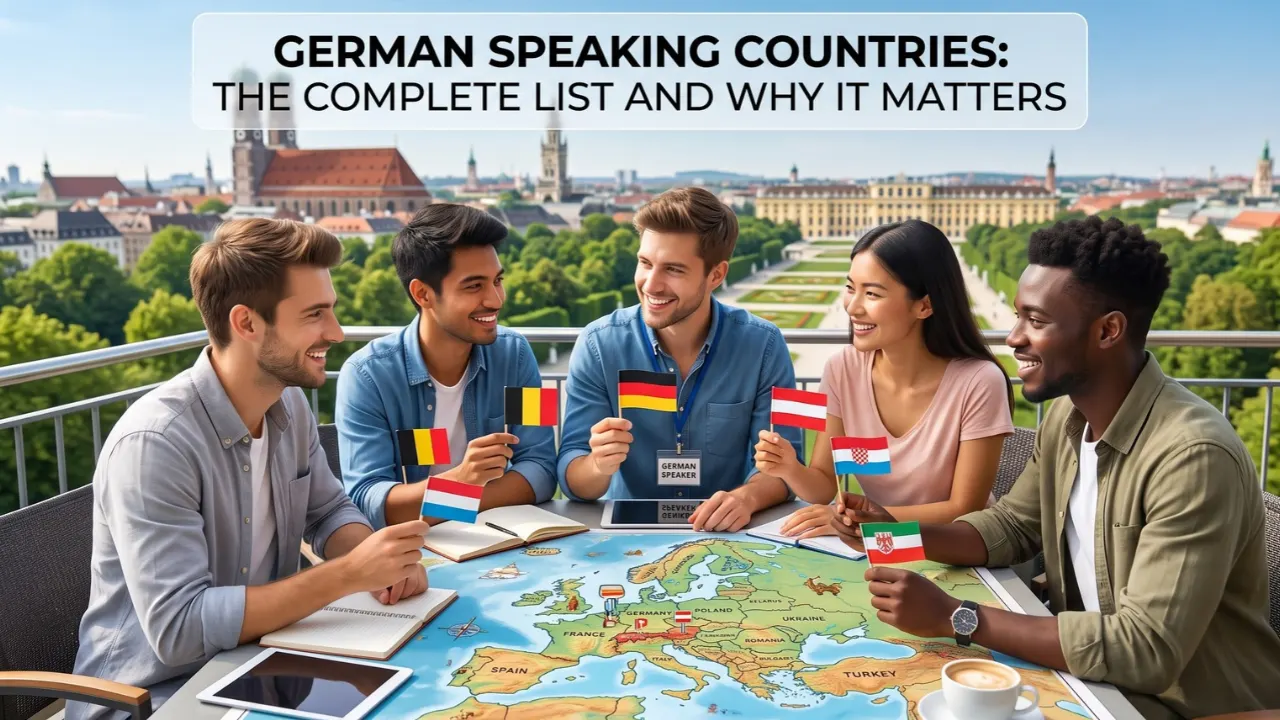
German is an official language in six countries and holds co-official or minority status in several more. Beyond that, deutsch language speaking countries and communities exist on nearly every continent, from Namibia to Argentina to the United States. This guide covers the full, accurate picture, official countries, co-official regions, and where German communities live worldwide.
| Country | Status | Population | Approximate share who speak German |
|---|---|---|---|
| Germany | Official | About 84 million | About 95 percent as a native language |
| Austria | Official | About 9 million | About 98 percent |
| Switzerland | Official (one of four) | About 8.7 million | About 62 percent |
| Belgium | Official (one of three) | About 11.7 million | Under 1 percent as a first language, concentrated in the East Cantons |
| Liechtenstein | Official | About 40,000 | About 92 percent |
| Luxembourg | Official (one of three) | About 660,000 | About 78 percent |
Countries that speak german fall into three real, distinct categories, and mixing them together is where most explanations of this topic go wrong. The first category is countries where German is an official language at the national level, six countries in total. The second is regions where German holds co-official or recognized minority status without being a national language, such as South Tyrol in Italy. The third category is german language speaking countries with established communities that formed through migration or colonial history, without any official status at all, such as Namibia, the United States, and parts of South America. Each category means something different, and this guide keeps them separate rather than blending them into one long list.
Six countries have German as an official national language: Germany, Austria, Switzerland, Belgium, Liechtenstein, and Luxembourg. This is the precise, verifiable count that matters for the question of official status. Beyond these six, several more countries and regions recognize German as a co-official or protected minority language, most notably South Tyrol in Italy, without German holding national official status there. Estimates of countries where german is spoken at any meaningful population level run higher, but figures above the mid-teens are typically counting historical diaspora communities rather than places where German holds any formal status, and should be treated with real caution unless a source is clearly cited.
This list of all german speaking countries with true national official status covers exactly six nations.
Germany is home to roughly 84 million people, and around 95 percent speak German as their native language, according to figures compiled by the CIA World Factbook. German is Germany’s sole official language at the federal level, and the country is by far the largest German speaking nation by both population and territory.
Austria has a population of roughly 9 million, with about 98 percent speaking German as their native language. The specific variety spoken is often called Austrian German, which differs from Standard German mainly in vocabulary and pronunciation, while remaining fully mutually intelligible with it.
Switzerland has four national languages, and German is the most widely spoken, used by roughly 62 percent of the population, concentrated in the central, northern, and eastern parts of the country. Spoken Swiss German, known as Schweizerdeutsch, differs enough from Standard German in pronunciation and vocabulary that it can be genuinely difficult for other German speakers to follow in conversation, even though written Swiss German stays close to the standard form.
Belgium has three official languages, Dutch, French, and German, each tied to a specific region under the Belgian Constitution. German is the smallest of the three, spoken as a first language by fewer than 1 percent of Belgians, concentrated in the East Cantons near the German and Luxembourg borders, a region with its own parliamentary government and a population of around 78,000.
Liechtenstein is a small country of about 40,000 people, and German is the national language, spoken as a first language by roughly 86 percent of the population and understood by around 92 percent overall. Various German dialects are spoken locally, including Alemannic and the Walser language.
Luxembourg has three official languages, Luxembourgish, French, and German. Luxembourgish, a dialect closely related to nearby German regional varieties, has been the national language since 1984 and is used by about 78 percent of the population, the same rough share that speaks German.
South Tyrol, an autonomous province in northern Italy bordering Austria and Switzerland, is the clearest example of German holding real, co-official status without being a national language. Roughly 62 percent of South Tyrol’s population speaks German as a first language, and the region operates with German as a fully co-official language alongside Italian, appearing on road signs, in schools, and in local government.
Several other countries recognize German as a protected minority language without any co-official status, including Czechia, Hungary, Poland, and Denmark, where a German speaking minority remains in the North Schleswig region near the German border. These recognitions matter culturally and legally within specific communities, but they are meaningfully different from South Tyrol’s fuller co-official status, and different again from full national official status.
Nearly every country where German holds any official or co-official status sits in central Europe, clustered around Germany itself. Germany, Austria, Switzerland, Liechtenstein, and Luxembourg form a contiguous block, while Belgium’s German speaking region sits just across the border from both Germany and Luxembourg. South Tyrol extends this cluster slightly further south into northern Italy. This geographic concentration is not a coincidence, it reflects centuries of shared political history, including the Holy Roman Empire and the Austro-Hungarian Empire, both of which used German as an administrative language across a much wider territory than modern Germany covers.
An official language is one recognized by law for government business, education, and legal proceedings at the national level. Germany, Austria, Switzerland, Belgium, Liechtenstein, and Luxembourg all meet this standard. Co-official status, South Tyrol’s situation, means a language is legally recognized and used in government and education within a specific region, without holding that status nationwide. A recognized minority language, the status held in Czechia, Hungary, Poland, and Denmark, offers legal protections and cultural recognition for a language community, but without the same institutional weight as co-official or official status. Understanding this distinction is the difference between an accurate answer and an inflated one when it comes to counting German speaking countries.
Established German speaking communities exist well beyond Europe, mostly rooted in specific, documented historical events rather than official language policy.
The geographic spread of German across central Europe traces back to two major historical periods. The Holy Roman Empire, which lasted roughly a thousand years until 1806, used German as a common administrative language across a territory that included much of modern Germany, Austria, and parts of surrounding countries. The Austro-Hungarian Empire later extended German’s administrative reach further into central and eastern Europe, which is part of why German still holds minority status in countries like Czechia and Hungary today. Germany’s colonial period in the late 19th and early 20th centuries, though far shorter and smaller in scale, explains the more distant German speaking communities in places like Namibia.
German is the most widely spoken native language in the European Union, ahead of French and Italian, since Germany alone accounts for such a large share of the EU’s total population. German is one of the EU’s 24 official languages, a status that reflects its use across Germany, Austria, Belgium, and Luxembourg, all EU member states.
Generally, yes, though with real variation. Standard German, used in media, education, and formal writing across all six official countries, is mutually understood by speakers everywhere. Regional spoken dialects are a different story. Spoken Swiss German in particular differs enough from Standard German in pronunciation and vocabulary that speakers from Germany or Austria can genuinely struggle to follow a casual conversation in it, even though Swiss German speakers themselves understand Standard German without difficulty, since they learn it in school.
Germany, Austria, Switzerland, Belgium, Liechtenstein, and Luxembourg are the six german official language countries, each with national official status.
Yes. German is one of Belgium’s three official languages, alongside Dutch and French, spoken as a first language by a small population concentrated in the East Cantons near the German border.
Yes, in South Tyrol, an autonomous province in northern Italy where German is co-official alongside Italian and spoken as a first language by roughly 62 percent of the region’s population.
Roughly 62 percent of the Swiss population speaks German, primarily in the central, northern, and eastern parts of the country.
Namibia has Africa’s largest German speaking population, a result of German colonial rule from 1884 to 1915, with roughly 20,000 to 30,000 native speakers remaining today.
There is no single official term in English, though “the German speaking world” and the German term Deutschsprachiger Raum are both commonly used to describe the six official countries together.
All six officially German speaking countries are in Europe, along with the co-official region of South Tyrol in Italy and recognized minority communities in several other European countries.
According to the CIA World Factbook, Germany’s population is approximately 84 million, with German spoken natively by the large majority, figures that align closely with those used throughout this guide.
Understanding where German is spoken is genuinely useful context before you start learning it. Reaching real fluency in any of these countries takes structured, guided practice. That is exactly what German Study Path’s live online German classes are built to provide. Small groups capped at a fixed number, native teachers, and levels from A1 through C2.
Fluency comes from a specific combination of real listening, active speaking, and consistency, not a single trick or app. This is the real, evidence based

Yes, for the course itself. Independent sources confirm online German classes typically run 10 to 20 percent cheaper than offline classroom training in India, since
Is German easy to learn? The honest answer is that German is moderately difficult, not effortless, but far more manageable than its reputation suggests. The
Yes, for the course itself. Independent sources confirm online German classes typically run 10 to 20 percent cheaper than offline classroom training in India, since