
Is German Easy to Learn? An Honest, Evidence Based Answer
Is German easy to learn? The honest answer is that German is moderately difficult, not effortless, but far more manageable than its reputation suggests. The



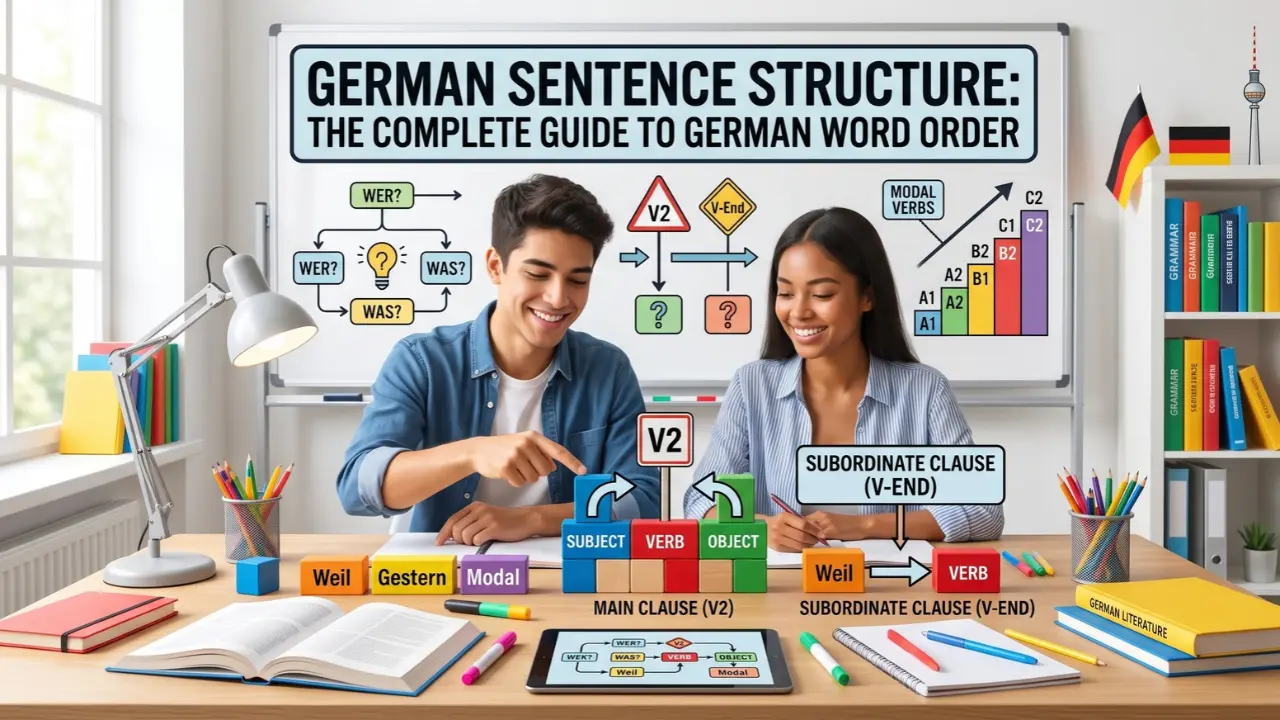
In a German main clause, the conjugated verb is always the second element. Not the second word. The second element, which can be one word or a whole phrase acting as a single unit. Once you understand this one rule, most of German sentence structure starts to make sense.
This guide walks through every part of German word order, from the first simple sentences you will build as a beginner to the small details that trip up learners at B1 and B2. It covers the core german grammar sentence structure rules step by step, and every German example below is fully translated, so you can follow along even before you know the vocabulary.
| Sentence type | Where the verb goes |
|---|---|
| Main clause (statement) | Second position |
| Yes or no question | First position |
| W question (wer, was, wo…) | Second position, after the question word |
| Subordinate clause (weil, dass, wenn…) | Final position |
| Sentence with a modal verb | Modal in second position, main verb at the end |
| Command (imperative) | First position, no subject stated |
Keep this table in mind. Every section below explains one row of it in detail, and together they cover the full picture of German sentence structure.
German sentence structure is the set of rules that decide where the subject, verb, and object go in a sentence. In English, word order carries almost all the meaning. “The dog bites the man” and “the man bites the dog” mean opposite things, because English depends on position to show who is doing what.
German works differently. German nouns and articles change form based on grammatical case, so the language does not need strict word order to show who is acting on whom. That case system frees up word order for other jobs, mainly emphasis, while one rule never bends: the position of the verb.
This matters in two real ways. First, comprehension. If you expect English style word order at all times, a German sentence with the object placed first will genuinely confuse you, even though it means exactly the same thing as the more familiar order. Second, accuracy. On the Goethe Institut and telc exams, German sentence structure is graded directly, not just vocabulary choice. A sentence with perfect words in the wrong order still loses points.
Only in the simplest sentences. “Ich esse einen Apfel” and “I eat an apple” line up word for word, subject, verb, object, in both languages. Comparing german sentence structure vs english side by side, the difference shows up the moment a sentence grows more complex, adds a question, or includes a second clause.
English keeps the subject and verb glued together no matter what else moves around the sentence. German does not. Because the verb has to hold its fixed position, the subject will move to make room for whatever element leads the sentence. This is the part that feels backward at first, but it follows a stricter, more predictable rule than English does, not a looser one.
Both, depending on the sentence. Main clauses in German follow SVO order, subject then verb then object, just like English. Subordinate clauses, the kind that start with words like weil or dass, switch to SOV order, with the verb pushed all the way to the end. This switch between the two patterns is the single biggest structural difference between German and English, and it is explained in full further down this page.
The verb second rule, often shortened to V2, is the most important concept in German sentence structure, and it is the rule every other pattern on this page builds on. In any main clause, whatever comes first, a subject, a time word, an object, an entire phrase, the conjugated verb takes the second position. Always.
Ich lerne Deutsch. (I am learning German.) The subject comes first, the verb second.
Heute lerne ich Deutsch. (Today I am learning German.) The time word comes first, the verb still holds position two, and the subject slides to third.
Jeden Tag lerne ich Deutsch. (Every day I am learning German.) A two word phrase now fills position one, but it still counts as one element, so the verb stays exactly where the rule requires.
This is where most English speakers stumble, not because the rule is complicated, but because it asks you to count elements instead of words. “Jeden Tag” is two words but one unit. The verb “lerne” is still, correctly, the second element in the sentence, even though it happens to be the third word.
Native speakers use this flexibility constantly to control emphasis. Starting a sentence with “Heute” puts weight on today specifically, rather than on the speaker. This is not an exception to German sentence order. It is the whole point of it. Once you can spot the second element quickly, sentence structure in german stops feeling random and starts feeling predictable.
The clearest way to make the V2 rule automatic is with full, translated example sentences, not fragments.
Ich trinke Kaffee. I drink coffee.
Du liest ein Buch. You are reading a book.
Er wohnt in Berlin. He lives in Berlin.
Wir lernen Deutsch. We are learning German.
Sie kauft ein Auto. She is buying a car.
Die Kinder spielen Fussball. The children play football.
Mein Bruder arbeitet in München. My brother works in Munich.
Das Wetter ist schön. The weather is nice.
Every subject here is followed immediately by a correctly placed verb, and every sentence stands on its own as a complete idea. Once these basic German sentences feel automatic, moving the first element around, as shown in the section above, becomes much easier, because you already know exactly where the verb has to land.
Yes, and it changes in a predictable, learnable way. German has two question types, and each one handles the verb differently.
For a question that can be answered with ja or nein, the conjugated verb moves to the very first position, ahead of the subject.
Trinkst du Kaffee? Do you drink coffee?
Wohnt er in Berlin? Does he live in Berlin?
Habt ihr Zeit? Do you have time?
W questions, named for the German question words, put the question word first and keep the verb in second position, just like a statement, only with the question word occupying slot one.
| German | English |
|---|---|
| wer | who |
| was | what |
| wann | when |
| wo | where |
| wohin | where to |
| woher | where from |
| warum | why |
| wie | how |
| wieviel | how much |
| welche | which |
Wo wohnst du? Where do you live?
Wann kommt der Zug? When does the train arrive?
Warum lernst du Deutsch? Why are you learning German?
Woher kommst du? Where are you from?
Wer, was, wann, wo, and warum, who, what, when, where, and why, are the core question words behind most German information questions. Wie, meaning how, usually joins this group too, even though it is not technically a W word in English. Learning these six words first will let you ask the majority of everyday questions in German.
Once a German sentence includes more than one extra detail, when something happened, how, and where, there is a standard ordering pattern learners often call TMP, time, manner, place, or in German, TeKaMoLo, standing for temporal, kausal, modal, and lokal.
Ich fahre morgen mit dem Zug nach Berlin. I am traveling tomorrow by train to Berlin.
Here, morgen (time) comes before mit dem Zug (manner), which comes before nach Berlin (place). This is the reliable default order. It is a strong pattern, not an absolute law. Native speakers do shift elements out of this order for emphasis, but for learners at A1 through B1, following time, then manner, then place will sound correct and natural almost every time.
A cause or reason, introduced by words like weil, denn, or deshalb, generally slots in before the time, manner, and place elements when it appears in the same sentence, which is where the K for kausal fits into the TeKaMoLo pattern.
Subordinating conjunctions, words like weil, dass, wenn, ob, and obwohl, push the conjugated verb all the way to the end of their clause. This is the single most common trip up for English speakers, because English never does this.
Ich bleibe zu Hause, weil ich krank bin. I am staying home because I am sick.
Ich weiss, dass du müde bist. I know that you are tired.
Wir gehen spazieren, wenn das Wetter gut ist. We go for a walk when the weather is good.
Notice that in each example, the verb (bin, bist, ist) sits at the very end of its clause instead of in the usual second position. This holds true for every true subordinating conjunction.
Not every connecting word triggers this shift. Coordinating conjunctions, such as und, aber, oder, and sondern, simply link two independent main clauses, and verb position stays normal in both halves. Subordinating conjunctions create a dependent clause and send the verb to the end.
Both words can translate to because, but they behave completely differently in German word order. Denn is coordinating, so it leaves normal word order untouched on both sides. Weil is subordinating, so it pushes the verb to the end of its clause.
Ich bin müde, denn ich habe schlecht geschlafen. I am tired, because I slept badly. Denn does not change the word order.
Ich bin müde, weil ich schlecht geschlafen habe. I am tired because I slept badly. Weil sends the verb, geschlafen habe, to the end.
A simple way to remember which is which: denn behaves like a period with a reason attached, the sentence right after it reads just like any other statement. Weil behaves like a hinge, it bends the whole clause around itself and holds the verb until the very end.
German modal verbs, können, müssen, wollen, sollen, dürfen, and mögen, follow the V2 rule for their own conjugated form, but they change what happens to the rest of the sentence. The main verb gets pushed to the very end, in its infinitive form.
Ich kann gut kochen. I can cook well.
Wir müssen jetzt gehen. We have to go now.
Sie will Deutsch lernen. She wants to learn German.
The modal verb (kann, müssen, will) sits in the normal second position, correctly matched to the subject. The main verb (kochen, gehen, lernen) sits at the very end, unconjugated. German grammar sometimes calls this pattern a verb bracket, because the modal and the main verb frame everything else in the sentence between them.
Separable verbs, such as aufstehen, anrufen, and mitkommen, split their prefix off in main clauses and send it to the very end of the sentence, following the same verb bracket pattern as modal verbs.
Aufstehen breaks down into two real parts. Auf means up, and stehen means to stand. Put together, aufstehen means to get up, and in a main clause, the two parts separate.
Ich stehe früh auf. I get up early.
Er ruft mich später an. He calls me later, from anrufen, an plus rufen.
Kommst du mit? Are you coming along, from mitkommen, mit plus kommen.
The conjugated part (stehe, ruft, kommst) stays in the normal second position, while the prefix (auf, an, mit) waits until the very end of the sentence. In a subordinate clause, the prefix reunites with the verb, so weil ich früh aufstehe keeps the whole word together at the end of the clause.
This is a genuinely useful rule that many learners never see explained clearly, so it is worth slowing down for, and it is one of the finer points of German sentence structure that separates confident intermediate speakers from beginners.
The basic rule: when a German sentence has both a dative object, usually a person, and an accusative object, usually a thing, the dative object comes first.
Ich gebe dem Lehrer das Buch. I give the teacher the book. Dem Lehrer is dative, das Buch is accusative, and the person comes before the thing.
The pronoun exception: if either object becomes a pronoun instead of a full noun, the order flips. Pronouns move ahead of nouns, and if both objects are pronouns, the accusative pronoun comes before the dative pronoun.
Ich gebe es dem Lehrer. I give it to the teacher. Es, the accusative pronoun, jumps ahead of the dative noun.
Ich gebe es ihm. I give it to him. Both are pronouns now, so the accusative es comes before the dative ihm.
A simple way to hold onto this: nouns follow the person first rule, dative before accusative, but pronouns always want to move forward, so once a pronoun enters the sentence, it earns the earlier spot, and if both objects are pronouns, the smaller, more object like accusative pronoun steps in front.
German splits negation between two words depending on what is being negated. Kein negates a noun that would otherwise take the indefinite article ein, or no article at all. Nicht negates everything else, verbs, adjectives, adverbs, and nouns that already carry a definite article.
Ich habe kein Auto. I do not have a car. Auto would normally take ein, so kein replaces it.
Ich kaufe das Auto nicht. I am not buying the car. Das Auto is definite, so nicht is used instead.
Ich verstehe das nicht. I do not understand that.
Position matters too. Nicht usually moves toward the end of the sentence when it negates the whole statement, but it sits immediately before the specific word or phrase it negates when the negation is narrower.
German has four grammatical cases, nominative for the subject, accusative for the direct object, dative for the indirect object, and genitive for possession. Each case changes a noun’s article and sometimes its ending, which marks its role in the sentence regardless of where it sits.
This is the real mechanical reason German language word order can move its first sentence element around so freely. Der Hund can only ever be the subject. Den Hund can only ever be a direct object. Since the case ending already shows the grammatical role, the position in the sentence is free to do a different job, signaling emphasis. English lost most of its case system long ago, which is exactly why English needs strict word order to do the job German case endings already handle. This is also why the order of words in german can shift for emphasis without ever confusing who did what to whom.
Commands in German drop the subject and put the verb first.
Komm her! Come here! Informal, singular.
Kommt her! Come here! Informal, plural.
Kommen Sie her! Come here! Formal.
Geh nicht! Do not go!
The formal command keeps Sie stated directly after the verb, the only imperative form that does this. Informal singular and plural commands drop the subject completely, since the verb ending alone tells the listener who is being addressed.
German sentence structure does not stay the same as your German improves. It builds in layers. Here is what genuinely changes at each stage of the CEFR framework.
At A1, you work with simple SVO statements, basic yes or no questions, and W questions, almost entirely in the present tense. The verb second rule appears here in its most basic form.
At A2, the perfect tense introduces the first real verb bracket, with haben or sein paired with a participle at the end of the sentence. Modal verbs appear too, adding a second bracket pattern, and simple weil clauses start showing up.
At B1, the full range of subordinating conjunctions comes into play, along with relative clauses. This is also where the dative and accusative pronoun ordering starts to matter for real accuracy, not just for being understood.
At B2, passive voice and the Konjunktiv II subjunctive appear, along with nested subordinate clauses, one dependent clause sitting inside another. Word order mistakes at this level cost real points on written exams, since graders expect near correct accuracy by this stage.
At C1, genitive constructions begin replacing simpler alternatives, and extended participial phrases appear before nouns, a distinctly German construction with no real English equivalent. Word order choices become stylistic tools, not just grammatical requirements.
At C2, you gain full command of word order flexibility for rhetorical and stylistic effect, including formal and literary registers where deliberate inversion is used for tone rather than by accident.
Sentence structure is not scored as its own separate category on the Goethe Institut or telc exams. It is folded into the written expression section, and it influences the speaking section too. In practice, examiners are trained to notice specific, recurring word order mistakes, a verb left in second position inside a subordinate clause, a fronted time phrase that forgets to move the subject, a separable prefix left stranded in the wrong place. None of this is a special exam trick. It is the same grammar covered on this page, just applied under time pressure without a dictionary. Each testing center publishes its own current scoring guidance and sample materials directly, and this section is offered as general background only.
These are the mistakes that show up most often in real student writing, and every one of them is easy to fix once you know what to look for.
Keeping the verb in second position inside a subordinate clause. Incorrect: Ich bleibe zu Hause, weil ich bin krank. Correct: Ich bleibe zu Hause, weil ich krank bin.
Forgetting to send the separable prefix to the end. Incorrect: Ich stehe auf früh. Correct: Ich stehe früh auf.
Using nicht where kein belongs. Incorrect: Ich habe nicht ein Auto. Correct: Ich habe kein Auto.
Keeping noun style dative accusative order after switching to a pronoun. Incorrect: Ich gebe dem Lehrer es. Correct: Ich gebe es dem Lehrer.
Placing two conjugated verbs in one clause. Incorrect: Ich kann spreche Deutsch. Correct: Ich kann Deutsch sprechen.
A little regular practice with German sentence structure goes a long way. Try each of these before checking the answer.
Reorder into a correct sentence: Deutsch, lerne, ich, jeden Tag. Answer: Jeden Tag lerne ich Deutsch.
Add weil and fix the verb position: Ich bin müde. Ich habe schlecht geschlafen. Answer: Ich bin müde, weil ich schlecht geschlafen habe.
Turn this into a yes or no question: Du trinkst Kaffee. Answer: Trinkst du Kaffee?
Replace das Buch with a pronoun and reorder: Ich gebe dem Lehrer das Buch. Answer: Ich gebe es dem Lehrer.
Fix the separable verb: Ich rufe an dich morgen. Answer: Ich rufe dich morgen an.
Practicing word order in german daily, even with short sentences in german like these, is what makes the rules automatic instead of something you have to think through every time.
No. Cases make flexibility possible, since they mark grammatical role through endings instead of position, but the verb’s position is still fixed no matter what case is involved. Cases explain why word order can move. They do not mean it can move anywhere at all.
Both are true at the same time. Verb position is strictly fixed by clause type, and that part never bends. Almost everything else, what leads the sentence, how time, manner, and place line up, has real, usable flexibility for emphasis. Learning to tell these two layers apart, the fixed part and the flexible part, is what makes German sentence structure start to feel logical instead of random.
What is the verb second rule in German?
In a main clause, the conjugated verb always takes the second position, whatever comes first in the sentence.
Does German always follow subject verb object order?
No. German main clauses often lead with a time phrase, an object, or an adverb instead of the subject, with the subject then moving to the position right after the verb.
Why does the verb move to the end in some German sentences?
Subordinating conjunctions like weil, dass, and wenn send the conjugated verb to the very end of their clause.
How do you ask questions in German?
Yes or no questions move the verb to the very first position. W questions put the question word first, then keep the verb in second position, just like a statement.
What happens to word order with modal verbs?
The modal verb takes the normal second position, and the main verb moves to the very end of the sentence in its infinitive form.
What are separable verbs, and where does the prefix go?
Separable verbs split apart in main clauses. The conjugated part stays in second position, and the prefix moves to the very end.
Is German word order flexible?
Verb position is fixed by clause type, but almost everything else has real flexibility for emphasis.
According to the German Wikipedia entry on sentence structure, German is classified as a verb second language in main clauses, following the same underlying pattern shared by most other Germanic languages apart from English.
Reading the rules on this page is the first step toward mastering German sentence structure. Producing them correctly, in real time, while actually speaking, is a different skill, one that reading alone does not build. That gap is exactly what German Study Path’s live online German classes are built to close. Small groups capped at a fixed number, native teachers correcting your word order as you speak, not after a quiz marks it wrong, across every level from A1 through C2, backed by a money back guarantee.
Is German easy to learn? The honest answer is that German is moderately difficult, not effortless, but far more manageable than its reputation suggests. The

Yes, you can learn German by yourself from B1 to B2. Two real, independently sourced estimates put the additional hours needed somewhere between 250 and

German is an official language in six countries and holds co-official or minority status in several more. Beyond that, deutsch language speaking countries and communities

Yes, for the course itself. Independent sources confirm online German classes typically run 10 to 20 percent cheaper than offline classroom training in India, since